Key Takeaways
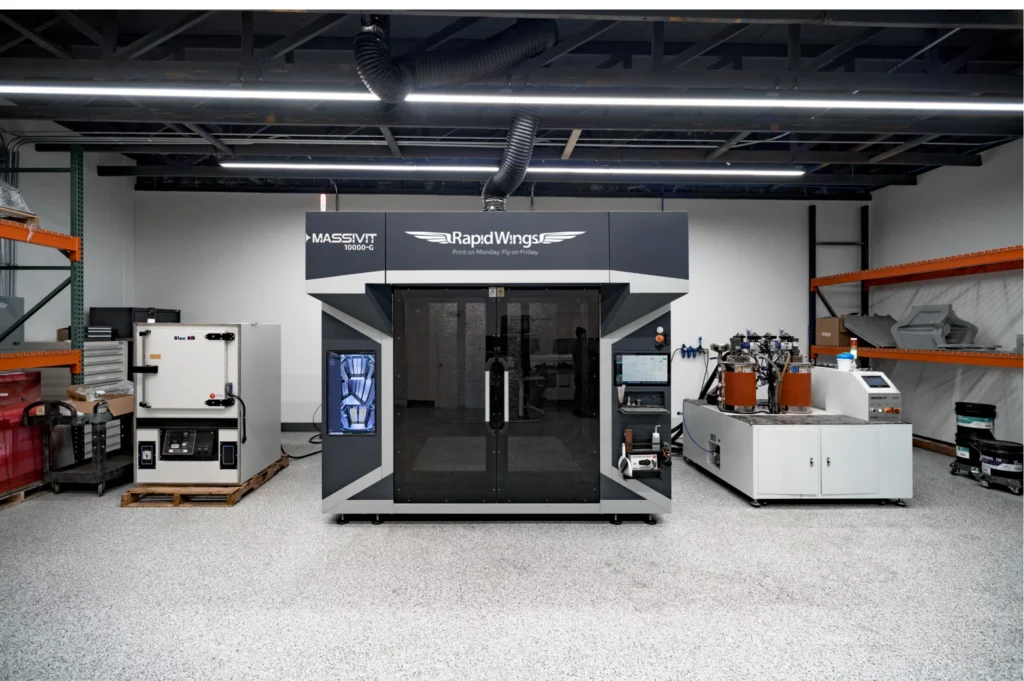
- Massivit’s RapidWings platform now offers on-demand composite tooling services in North America through a partnership with Oregon-based Artek.
- The Cast-In-Motion (CIM) process creates isotropic molds up to 2.5 m × 1.5 m with a typical lead-time of 10-14 days, cutting cycle time by roughly 50 % versus conventional CNC milling.
- Fives AddUp’s new large-format LPBF system (2026) targets aerospace-grade titanium parts up to 1 m³ and promises a 30 % reduction in build cost.
- An AI-driven design platform now automates PCB enclosure generation, linking topology-optimized CAD directly to CNC-compatible STL output.
RapidWings Expands to North America
Massivit, the Israeli leader in high-speed composite printing, has extended its RapidWings turnkey platform from Europe to the United States. The expansion hinges on a strategic alliance with Artek Energy, a Portland-based design-and-manufacturing firm that will host a dedicated RapidWings service hub.
What the Service Hub Offers
| Service | Description | Typical Turn-Around |
|---|---|---|
| Digital Tooling | 3-axis and 5-axis CNC-compatible CAD files generated from CIM data | 2 days |
| Full-Scale Prototypes | Large-area composite molds (up to 2.5 m × 1.5 m) printed in-place | 7-10 days |
| Tool Finishing | CNC-machined surface refinement to ±0.02 mm tolerance | 3-4 days |
| On-Site Demonstrations | Live CIM runs for customer validation | By appointment |
The core of the offering is Massivit’s Cast-In-Motion (CIM) technology, which fuses dual-component photopolymers with a high-speed, continuous-feed extrusion system. The result is an isotropic composite mold that can withstand 10 kpsi without delamination—far beyond the anisotropic strength of most traditional CNC-milled aluminum tooling (≈ 6 kpsi).
“CIM gives us a 30 % cost advantage and halves the lead-time compared with conventional CNC-machined tooling,” said Lior Ben-Shalom, VP of Global Operations at Massivit.
Fives AddUp Rolls Out a New Large-Format LPBF System
In parallel, Fives AddUp announced the U.S. launch of its L-Series 3D-LPBF machine, engineered for aerospace-grade Ti-6Al-4V and Inconel 718. Key specifications include:
- Build envelope: 1 m × 1 m × 1 m (≈ 1 m³)
- Laser power: 2 kW fiber laser with 200 µm spot size
- Layer thickness: 20-100 µm (adjustable)
- Energy efficiency: 30 % lower electricity draw versus 2023 baseline
The system integrates a closed-loop powder reclamation loop, delivering a 95 % reuse rate and reducing material waste to under 5 kg per build.
AI-Powered PCB Enclosure Designer Bridges to CNC
A new AI platform, EnclosureAI, now automates the design of custom 3-D-printable PCB housings. The workflow is:
- Upload a Gerber file or 3-D model of the PCB.
- AI engine runs topology optimization, generating a lightweight lattice that meets thermal and EMI constraints.
- Export options include STL (for CNC-compatible subtractive machining) or AM-ready G-code.
Early adopters report a 40 % reduction in enclosure weight (average 12 g vs 20 g) and a 25 % cut in design-to-production time.
RapidWings vs. Traditional CNC Milling – A Quick Comparison
| Attribute | RapidWings CIM (Composite) | Conventional CNC-Milled Aluminum |
|---|---|---|
| Maximum Tool Size | 2.5 m × 1.5 m | 1.8 m × 1.2 m (typical 5-axis) |
| Lead-Time | 10-14 days (full cycle) | 20-30 days (tooling + machining) |
| Material Cost | ~ $45 / kg composite resin | ~ $30 / kg aluminum (plus machining) |
| Surface Isotropy | 10 kpsi (uniform) | 6 kpsi (direction-dependent) |
| Post-Process | Minimal CNC finishing (±0.02 mm) | Full CNC machining required |
| Environmental Impact | 5 kg powder waste (recyclable) | 12 kg metal shavings (non-recyclable) |
Bottom Line
Massivit’s RapidWings expansion, anchored by Artek’s Portland hub, gives North-American defense and aerospace manufacturers a faster, cheaper


