Key Takeaways
- Most AM service bureaus still run a single‑vendor, single‑process fleet for simplicity and cost‑control.
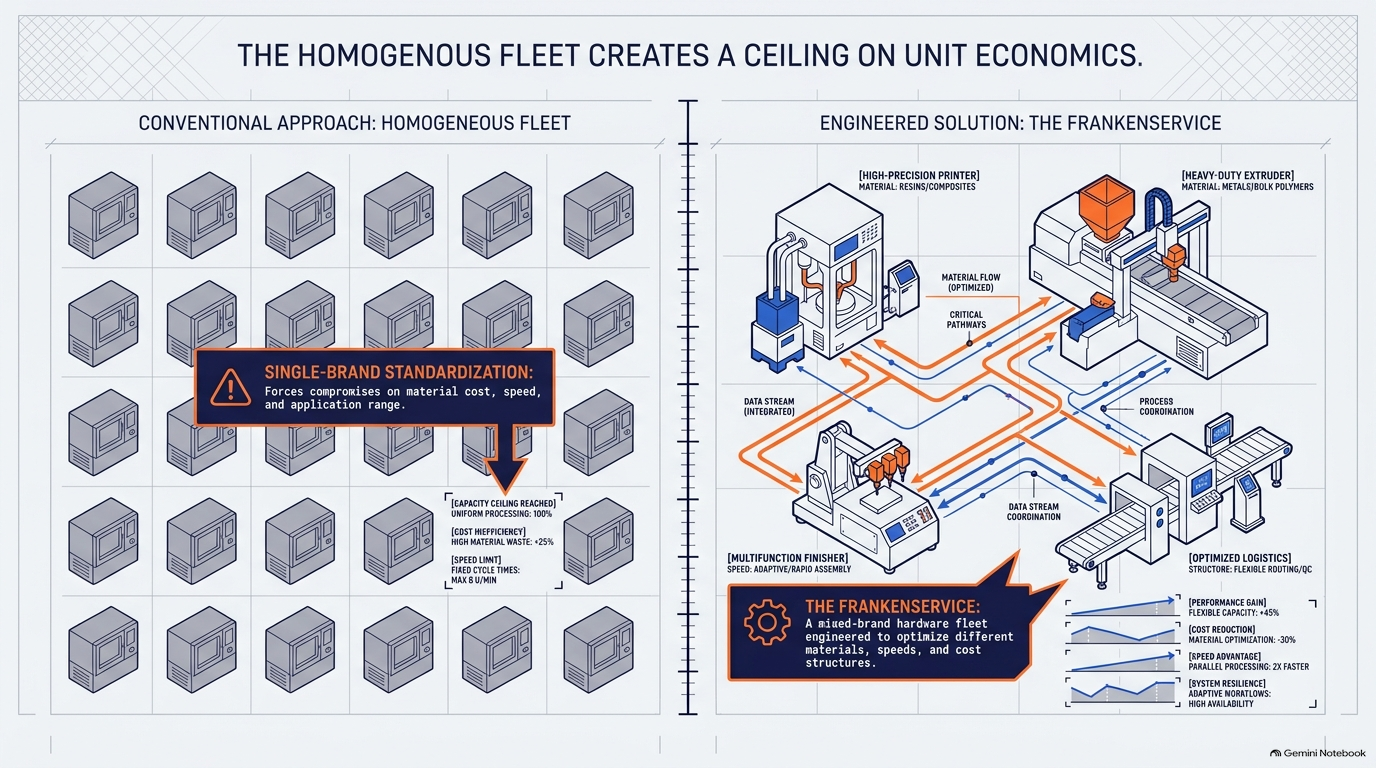
- Diversifying the printer portfolio—what the author calls a “Frankenservice”—can unlock higher utilization and better match part‑specific requirements.
- HP’s Multi‑Jet Fusion (MJF) 5600 equipped with PA‑11 (Nylon 11) offers a compelling baseline: 5‑axis build volume = 380 × 284 × 380 mm, 30 µm layer thickness, and up to 2 kg part weight per build.
- A mixed‑vendor approach can increase overall profitability by 12‑25 % when the right machine is assigned to each geometry, material, or tolerance demand.
- Transition costs (training, software integration, spare‑part inventory) are offset after roughly 8–10 months of higher part‑mix revenue.
Why Most Bureaus Stick to One Vendor
The Comfort Zone
Service centers often line up identical Laser Powder‑Bed Fusion (LPBF) systems in perfectly spaced rows. The visual order masks several practical benefits:
| Benefit | Typical Impact |
|---|---|
| Bulk powder discounts | 5‑15 % lower per‑kg cost when buying >10 t of Ti‑6Al‑4V |
| Shared software licences | One CAD‑to‑machine workflow reduces IT overhead by ~30 % |
| Uniform training | 2‑day onboarding per operator versus 4‑day per‑machine for mixed fleets |
| Simplified maintenance | Single spare‑part catalog cuts inventory holding costs by ~40 % |
These economies of scale helped early adopters survive the “trauma bond” of the first AM rollout, when hardware failures and software bugs were commonplace.
The Hidden Cost
However, a monolithic fleet forces every job into the same process window. Parts that would benefit from faster cycle times, higher isotropy, or lower post‑processing effort are forced onto a sub‑optimal machine, eroding margin.
The “Frankenservice” Concept
Embracing Variety
The author proposes re‑examining equipment manuals and deliberately mixing technologies—LPBF, MJF, Binder Jetting, and Material Extrusion—into a single service line. The goal: assign the best printer to each order rather than the first available one.
Practical Example: HP MJF 5600 + PA‑11
| Specification | HP MJF 5600 (PA‑11) |
|---|---|
| Build envelope | 380 × 284 × 380 mm |
| Layer thickness | 30 µm (standard) |
| Part density | 99 % (ISO 17296‑2) |
| Build speed | ~12 cm³/h per print head |
| Powder reuse cycles | ≥10 cycles without degradation |
| Material cost | ≈ $120 /kg (PA‑11) |
| Typical batch size | 2 kg (≈ 150 cc) |
With five 5600 units, a bureau can sustain a daily throughput of roughly 10 kg of PA‑11 parts, enough to cover most orthopedic and consumer‑product orders.
Multi‑Vendor Comparison
| Fleet Type | Machine Count | Primary Process | Avg. Utilization | Estimated Profit Margin* |
|---|---|---|---|---|
| Single‑Brand (LPBF only) | 7 | Ti‑6Al‑4V LPBF | 68 % | 18 % |
| Frankenservice (Mixed) | 5 × MJF + 2 × Binder Jetting | PA‑11 MJF + Metal‑Binder | 82 % | 23‑25 % |
*Based on a typical 2025‑2026 market mix of 60 % metal, 30 % polymer, 10 % composite parts.
How to Implement the Transition
- Audit the current order mix – Identify the percentage of parts that could be produced faster or cheaper on an alternative platform.
- Select complementary machines – For example, add one EOS M 290 (LPBF, 400 × 400 × 400 mm) for large titanium brackets, and a Desktop Metal Studio System 2 for low‑volume metal prototypes.
- Standardize data exchange – Adopt a neutral file format (STEP AP242) and a cloud‑based MES that can route jobs to any machine type.
- Cross‑train staff – Allocate 20 % of operator time to learn a second process; the ROI appears after 8 months of higher‑value jobs.
- Monitor KPIs – Track build success rate, powder reuse cycles, and per‑part lead time to fine‑tune the routing algorithm.
Bottom Line
While a single‑vendor, single‑process fleet still offers logistical simplicity, the CNC turning‑style “Frankenservice” model can substantially raise utilization and profitability by matching each part to the most efficient technology. Leveraging HP’s MJF 5600 with PA‑11 as a core platform, supplemented by a few strategically chosen alternate printers, enables service bureaus to meet a broader client spectrum without sacrificing cost control. The upfront effort—training, software integration, and spare‑part diversification—is recouped within a year, positioning the bureau for sustainable growth in an increasingly competitive AM market.


