Key Takeaways
- Titan HP adds per‑device thermal control, keeping each AI chip at its target junction temperature while executing a realistic workload.
- The system delivers up to 1.5 kW per slot, far beyond the 200‑300 W typical of conventional burn‑in ovens.
- Asynchronous slot architecture eliminates idle time: a long stress run on one device does not halt the others.
- All stress‑and‑test data are stored on a single device‑level record, simplifying traceability for reliability programs.
- Titan HP runs on the Terrazne Atlas software suite, enabling seamless migration of existing test programs and future‑proofing for AI accelerators that will exceed 500 W per die.
Teradyne Unveils Titan HP – A Production‑Ready Platform for AI Chip Burn‑In
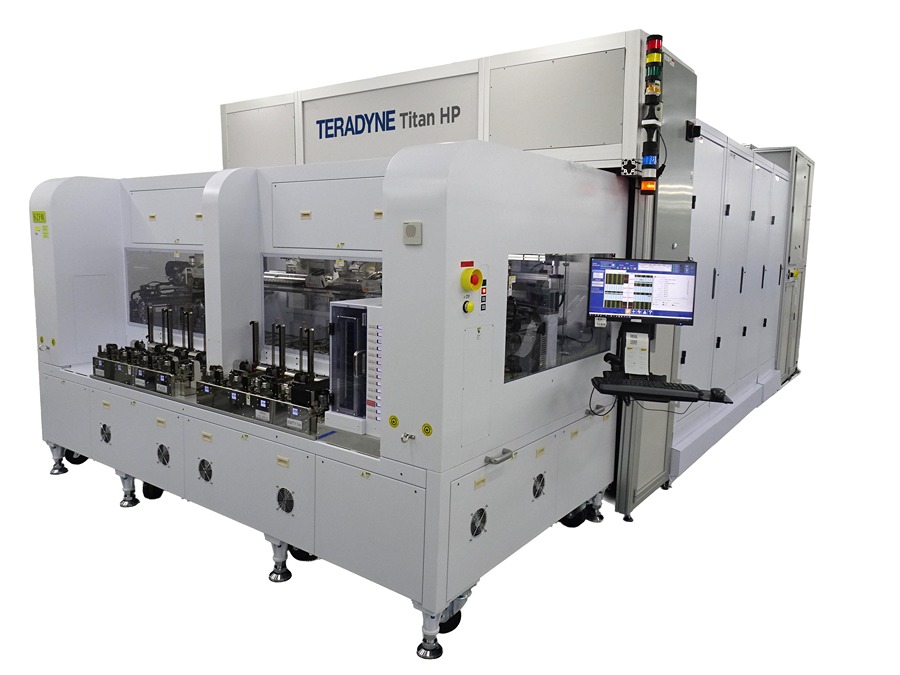
Teradyne, Inc. has announced that its Titan HP platform is now ready for high‑volume deployment. The system re‑imagines burn‑in testing for AI data‑center processors by shifting from traditional oven‑based temperature control to per‑device junction‑temperature regulation while the chip runs a representative workload. This approach aligns thermal stress with real‑world operating conditions, delivering more accurate reliability data and higher throughput.
How Titan HP Differs From Conventional Burn‑In
| Feature | Traditional Oven Burn‑In | Titan HP (Teradyne) |
|---|---|---|
| Temperature control | Uniform air temperature (typically 150‑200 °C) for a whole bank of devices | Individual junction‑temperature setpoint per device (up to 250 °C) |
| Power delivery | Limited to 200‑300 W per device (air‑flow constrained) | Up to 1.5 kW per slot, supporting high‑power AI accelerators |
| Test concurrency | Devices share a single oven; long stress runs block the whole bank | Asynchronous slot architecture – each slot runs independently |
| Data traceability | Separate logs for burn‑in and functional test | Unified device‑level record covering stress and functional results |
| Scalability | Capital‑intensive ovens; limited by airflow and space | Modular slots; easy expansion without additional ovens |
Traditional Burn‑In Limitations
Conventional burn‑in rigs place dozens of chips in a temperature‑controlled oven and hold them there for several hours. The environment is air‑temperature‑only, which does not reflect the actual heat generated by a chip under load. Moreover, when one device requires an extended stress cycle, the entire bank remains idle, inflating cycle time and capital expense.
Titan HP’s Per‑Device Thermal Management
Titan HP equips each slot with a high‑precision power supply and a closed‑loop thermal sensor that monitors the chip’s junction temperature in real time. The system can ramp power to 1.5 kW per slot, enabling stress conditions that mimic the 500 W‑plus power draw expected from next‑generation AI accelerators. Engineers set a target junction temperature (e.g., 230 °C) and the platform automatically adjusts voltage and current to maintain it, regardless of device‑to‑device variations.
Architectural Advantages
Asynchronous Slot Design
Each slot operates on its own timeline. If a particular AI die requires a 48‑hour high‑stress run, the remaining slots continue testing other devices. This parallelism can improve overall throughput by 30‑45 % compared with batch‑oven approaches.
Serviceability Without Downtime
Because slots are electrically isolated, a technician can service or replace a faulty module while the rest of the system stays online. This reduces scheduled maintenance windows from days to a few hours.
Software Integration with Atlas
Test programs are authored on the Terrazne Atlas platform, a GUI‑driven environment that supports both import of legacy scripts and creation of new workloads. Atlas automatically maps the workload to the per‑device power and thermal limits defined in Titan HP, ensuring compliance with the target stress profile. The same Atlas scripts can be ported to other Terrazne system‑level testers, protecting the investment in test development as product lines evolve.
Future‑Proofing for AI Accelerators
Terrazne’s roadmap anticipates AI chips that will exceed 1 kW total power and operate at junction temperatures above 250 °C. Titan HP’s modular power architecture and software abstraction layer are designed to scale with these demands, allowing customers to upgrade slot modules rather than replace entire burn‑in infrastructure.
Bottom Line
Teradyne’s Titan HP delivers a paradigm shift in AI chip reliability testing by marrying per‑device junction‑temperature control with high‑power delivery and asynchronous operation. The platform not only shortens cycle time and lowers capital outlay but also provides a single, traceable record for each device’s stress history. Coupled with the Atlas software suite, Titan HP positions semiconductor manufacturers to meet the escalating power and thermal challenges of next‑generation AI accelerators while preserving test‑program investments.