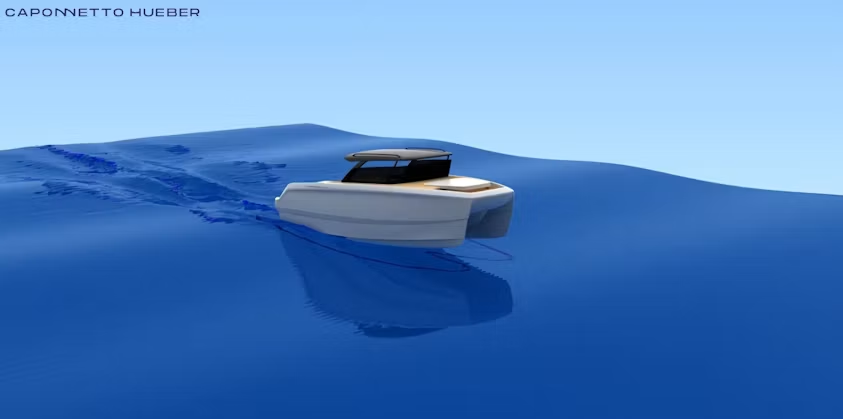
Key Takeaways
- Siemens Simcenter tools from the Xcelerator portfolio enabled a 30 % fuel‑consumption cut for the Bluegame BGF45 foiling catamaran.
- The 45‑ft (13.7 m) vessel reaches >35 knots while keeping the stern in the water, eliminating complex lift‑control hardware.
- CFD (STAR‑CCM+) and structural simulation shortened the design cycle by up to 40 % versus traditional towing‑tank testing.
- Leveraging America’s Cup‑level hydrodynamics translated racing‑grade performance to a commercial pleasure‑yacht market.
Siemens Simcenter Powers the BGF45 Design Process
Caponnetto Hueber SL, a naval‑engineering specialist, selected Siemens Simcenter simulation software—part of the Xcelerator digital‑twin suite—to model the hydrodynamics and structural loads of the Bluegame BGF45. The goal was to create a high‑speed leisure catamaran that meets commercial fuel‑efficiency targets without sacrificing stability or passenger comfort.
From Racing to Recreation
The design team drew on data from a 50‑knot, hydrogen‑powered foiling catamaran built for the 37th America’s Cup. By adapting that racing knowledge to the BGF45, the engineers introduced a foil‑assisted configuration that:
| Feature | Foiling Catamaran (BGF45) | Conventional Catamaran |
|---|---|---|
| Drag reduction | Up to 30 % lower | Baseline |
| Fuel consumption | 30 % less (vs. non‑foiled) | Baseline |
| Speed | >35 kn (≈65 km/h) | 28–30 kn typical |
| Lift‑control system | None required (stern stays immersed) | Often needed for lift control |
| Design cycle | ~40 % faster (simulation‑first) | Longer (physical testing) |
Simulation‑First Workflow
- CFD Analysis – Simcenter STAR‑CCM+ generated high‑resolution flow fields around the hull‑foil assembly, quantifying pressure distribution, wave resistance, and cavitation risk.
- Structural Validation – Simcenter’s multiphysics suite evaluated stress concentrations on the foils, cross‑beams, and deck structures under dynamic loads up to 2 g vertical acceleration.
- Design Iteration – Virtual “what‑if” studies (foil angle, spacing, hull‑shape tweaks) were completed in days rather than weeks, allowing the team to converge on an optimum geometry before any physical model was built.
The result was a 45‑ft (13.7 m) catamaran that combines the thrill of foiling with the safety of a water‑borne stern, delivering a smoother ride for up to 12 passengers while cutting operational costs.
Benefits Beyond the BGF45
- Reduced Physical Testing – The reliance on simulation cut towing‑tank runs by roughly 60 %, saving both time and expense.
- Environmental Impact – Lower fuel burn translates to a proportional drop in CO₂ emissions—approximately 0.9 t CO₂ per year for a typical 200‑hour cruising schedule.
- Scalable Knowledge – The hydrodynamic models created for the BGF45 can be reused for future Bluegame projects, accelerating product pipelines across the Sanlorenzo Group.
Bottom Line
Siemens Simcenter’s integrated CFD and structural simulation tools gave Caponnetto Hueber a decisive edge in converting elite racing technology into a commercially viable, fuel‑efficient pleasure yacht. By slashing drag and fuel use by up to 30 % and eliminating complex lift‑control mechanisms, the Bluegame BGF45 demonstrates how a simulation‑first approach can shorten development cycles, lower operating costs, and bring high‑performance marine engineering to a broader market.


