Key Takeaways
- Siemens + Mescada deliver a full‑stack digital‑twin platform (gPROMS + COMOS) for InterContinental Energy’s patented P2(H₂)Node.
- The twin can cut green‑hydrogen production costs by up to 20 % and accelerate design cycles from years to months.
- Each node pairs 1‑1.3 GW of AI‑compute‑driven electrolysis with ≈ 2.6 GW of wind/solar, targeting gigawatt‑scale hydrogen hubs.
- The $3.12 M Australian Renewable Energy Agency (ARENA) grant funds 50 % of the pilot, enabling rapid replication.
Overview
Siemens, together with solution integrator Mescada, is supplying the digital‑engineering backbone that lets InterContinental Energy (ICE) turn its proprietary P2(H₂)Node concept into a repeatable, licensable blueprint for large‑scale, renewable‑powered AI compute and green‑hydrogen generation. The world‑first digital‑twin approach promises a 20 % reduction in the levelized cost of hydrogen (LCOH) while delivering a scalable template that can be rolled out faster than traditional front‑end engineering methods.
How the Digital Twin Operates
| Component | Role in the Twin | Key Capability |
|---|---|---|
| gPROMS (Siemens) | Process‑modelling engine | Runs high‑fidelity thermodynamic and electro‑chemical simulations; integrates with ICE’s Python‑based optimizer. |
| COMOS (Siemens) | Engineering data platform | Stores equipment specs, generates P&IDs, and maintains a single source of truth for all node variants. |
| Mescada | Integration & support | Coordinates software onboarding, provides first‑line technical assistance, and escalates issues to Siemens. |
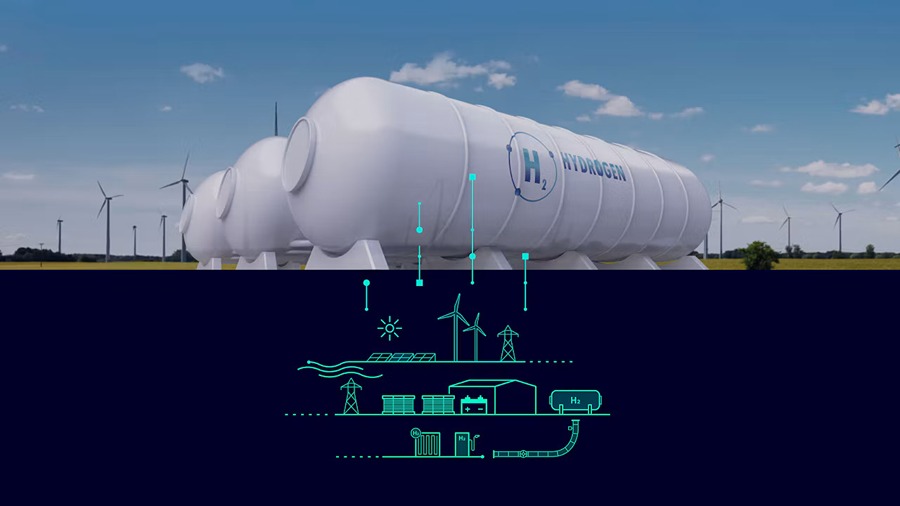
The twin creates a virtual replica of the P2(H₂)Node, linking hydrogen electrolysis to wind/solar output and AI‑compute loads. Engineers can swap electrolyzer models, change turbine ratings, or simulate demand spikes, and instantly see impacts on efficiency, capital expenditure (CAPEX), and operating expenditure (OPEX). Results feed into the Front‑End Engineering Design (FEED) stage, informing the Final Investment Decision (FID) with data‑driven confidence.
Technical Specs of a P2(H₂)Node
- AI Compute + Electrolysis Capacity: 1.0 – 1.3 GW (≈ 30 % of total node power)
- Renewable Generation: ~2.6 GW of combined wind and solar PV
- Hydrogen Output: Up to 150 t/day at 99.9 % purity (based on 70 % electrolyzer efficiency)
- Grid Interaction: Flexible load‑following; can absorb excess renewable generation or provide demand response services.
- Digital‑Twin Resolution: 1‑second time‑step simulation for real‑time scenario testing.
Funding & Partnership Structure
- Total pilot budget: US $3.12 M
- ARENA contribution: US $1.56 M (50 % of total) under the Advancing Renewables Program
- Roles:
- Siemens: Supplies gPROMS, COMOS, and escalation support.
- Mescada: Manages software delivery, onboarding, and day‑to‑day technical support.
- ICE: Provides the P2(H₂)Node IP, runs the optimization workflow, and steers the commercial rollout.
Benefits vs. Conventional Engineering
| Metric | Traditional FEED Approach | Siemens‑Mescada Digital‑Twin |
|---|---|---|
| Design Cycle | 18‑24 months | 6‑9 months (≈ 65 % faster) |
| LCOH Reduction | Baseline | Up to 20 % lower |
| Capital Forecast Accuracy | ±10‑15 % | ±3‑5 % (thanks to scenario‑rich simulation) |
| Scalability | Site‑specific, limited reuse | Template‑driven, plug‑and‑play across multiple sites |
| Risk Exposure | High (late‑stage redesign) | Low (virtual validation before hardware) |
Bottom Line
Siemens’ integration of gPROMS and COMOS, delivered through Mescada’s implementation services, equips ICE with a high‑fidelity digital twin that transforms a complex, gigawatt‑scale hydrogen‑AI node from a prototype into a market‑ready, licensable asset. By slashing design time, tightening cost forecasts, and delivering a demonstrable 20 % LCOH reduction, the solution sets a new benchmark for renewable‑hydrogen engineering. With ARENA’s co‑funding, the project also showcases a viable financing model for rapid, repeatable deployment of green‑hydrogen hubs worldwide.


