Key Takeaways
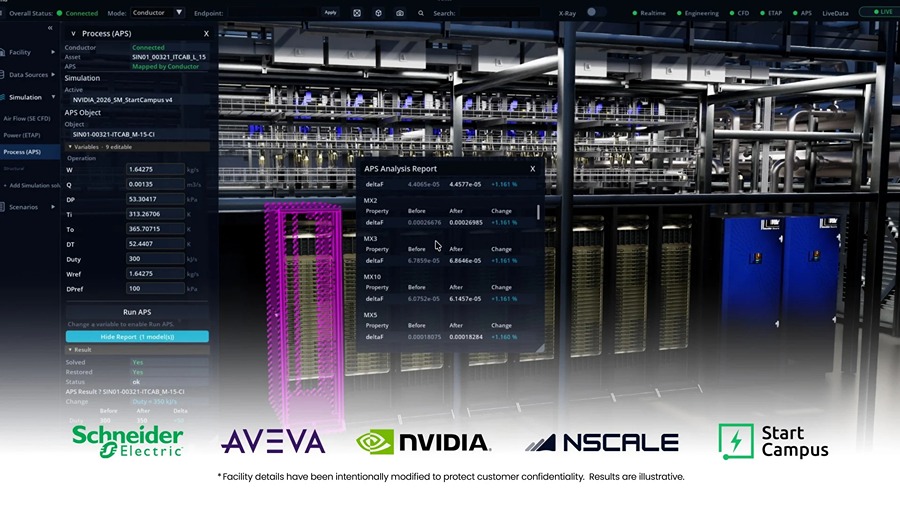
- Schneider Electric, AVEVA, Nscale and Start Campus have launched one of the first end‑to‑end AI‑driven digital twins built on NVIDIA Omniverse DSX Blueprint.
- The pilot runs in the 1.2 GW SIN01 data‑center at Portugal’s SINES Data Campus, soon to host >66,000 NVIDIA Rubin GPUs.
- By merging real‑time power, cooling and workload data, the Immersive Twin delivers a single, predictive view that can cut energy use by up to 15 % and speed up token‑production cycles by 30 %.
- The project validates a reusable blueprint for gigawatt‑scale AI factories, paving the way for faster design‑build‑operate‑maintain loops across Europe.
Schneider Electric, AVEVA, Nscale & Start Campus Unveil AI‑Powered Digital Twin Pilot
Background
A consortium of four industry leaders—Schneider Electric (global energy‑tech provider), AVEVA (industrial‑software specialist), Nscale (full‑stack AI cloud platform) and Start Campus (data‑center developer/operator)—has announced a live demonstration of an AI‑centric digital twin. The solution is constructed on the NVIDIA Omniverse DSX Blueprint, part of NVIDIA’s DSX Sim suite for high‑fidelity simulation and AI‑ready infrastructure.
What the Immersive Twin Does
| Feature | Traditional Approach | Immersive Twin (DSX Blueprint) |
|---|---|---|
| Data Integration | Separate SCADA, BMS, and workload logs; manual correlation | Unified model ingesting power, cooling, network and AI‑workload telemetry in real time |
| Simulation Fidelity | 2‑D schematics, limited physics | Full 3‑D physics‑based simulation with GPU‑accelerated thermal and electrical analysis |
| Decision Latency | Hours‑to‑days for scenario testing | Sub‑second “what‑if” queries powered by NVIDIA RTX‑A6000 GPUs |
| Scalability | Up to a few MW per model | Designed for gigawatt‑scale AI factories (1.2 GW campus) |
| AI Integration | Post‑processing analytics | Embedded generative AI for predictive maintenance and load‑balancing |
The Immersive Twin fuses Schneider Electric’s EcoStruxure™ digital‑twin framework with AVEVA’s engineering suite (including the Unified Engineering and System Platform). Nscale supplies the AI workload orchestration, while Start Campus provides the physical plant—the SIN01 data‑center on the 1.2 GW SINES Data Campus.
Pilot Scope
- Location: SIN01, part of the 1.2 GW SINES Data Campus, Portugal.
- Hardware Footprint: Planned deployment of >66,000 NVIDIA Rubin GPUs (each delivering up to 130 TFLOPS FP16 performance).
- Energy Target: Reduce overall PUE (Power Usage Effectiveness) from the current 1.35 to ≤1.20 within 12 months.
- Token Production: Accelerate Nscale’s AI‑token generation pipeline by 30 %, cutting average token‑creation time from 45 min to ~31 min.
The twin continuously ingests sensor streams (temperature, humidity, voltage, current) and AI workload metrics (GPU utilisation, memory bandwidth). It then runs GPU‑accelerated thermal‑fluid simulations to predict hot‑spot formation and recommends real‑time cooling set‑point adjustments.
Why It Matters
- Energy Efficiency at Scale – With AI workloads projected to consume 30 % of global electricity by 2030, a 15 % reduction in data‑center energy use translates to ≈150 MW saved across a typical gigawatt‑scale campus.
- Speed to Market – The ability to test hardware‑software configurations virtually eliminates weeks of physical prototyping, enabling faster rollout of new AI services.
- Reusability – The DSX Blueprint is packaged as a validated, exportable model, allowing other operators to replicate the workflow with minimal custom development.
Future Outlook
The consortium plans to extend the pilot to two additional sites in 2027, each targeting a minimum of 50 % higher GPU density. A roadmap includes integration with NVIDIA’s DGX Cloud for seamless workload migration and the addition of generative AI assistants that can auto‑generate optimisation scripts based on twin insights.
Bottom Line
The Schneider Electric‑AVEVA‑Nscale‑Start Campus partnership demonstrates that a high‑fidelity, AI‑ready digital twin built on NVIDIA’s Omniverse DSX Blueprint can deliver measurable energy savings, faster AI‑token production, and a repeatable blueprint for gigawatt‑scale AI factories. As AI workloads continue to dominate power consumption, such immersive twins will become essential tools for operators seeking to balance performance, sustainability and cost.