Key Takeaways
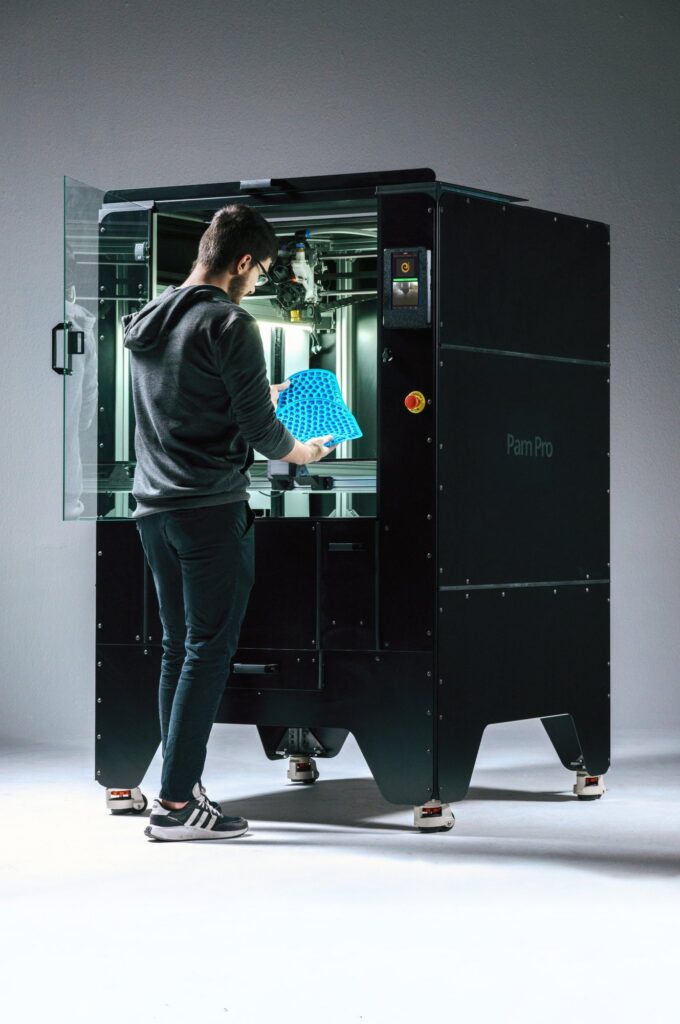
- Pollen AM + RHEON Labs showcased a pellet‑extrusion system (PAM Pro) that can print a strain‑rate‑sensitive polymer (P3D 001) for football‑helmet liners.
- The material behaves soft in normal use and stiffens instantly under impact, matching the performance goals of modern protective gear.
- Pellet‑based AM promises material costs near injection‑mold pricing and higher part‑volume throughput than conventional filament‑FDM or DLS processes.
- At Formnext 2024 (Hall 12.1, Stand A78) the duo demonstrated a full‑scale helmet liner printed directly from polymer pellets, highlighting a potential shift toward low‑cost, high‑volume production.
Introduction: Why 3‑D‑Printed Helmet Liners Matter
Additive manufacturing (AM) has already begun to reshape the design of football helmets, allowing engineers to embed complex lattice structures that absorb impact more efficiently than traditional foam. The next frontier is to produce those lattices directly from raw polymer pellets, eliminating the filament‑spooling step and reducing material waste.
The Players
Pollen AM
- French OEM and service bureau specializing in material‑extrusion printers for polymers, metals, and ceramics.
- Developed the PAM Pro pellet‑extrusion platform, engineered for production‑scale throughput (up to 150 kg h⁻¹ of polymer).
RHEON Labs
- London‑based developer of a strain‑rate‑sensitive metamaterial.
- Marketed as “soft in normal use, dynamically stiffens and dissipates energy on impact.”
- Material designation: P3D 001, supplied as pellets (≈ 25 mm diameter).
How Pellet 3‑D Printing Works
- Pellet Feeding – Bulk polymer pellets are metered into a heated barrel (typical melt temperature ≈ 210 °C for P3D 001).
- Extrusion – A screw‑driven extruder pushes the melt through a nozzle (0.4 mm to 1.2 mm diameter).
- Layer Deposition – The PAM Pro’s motion system deposits material in continuous, high‑speed paths, achieving print rates of 30–45 mm³ s⁻¹.
- In‑situ Cooling – A controlled cooling zone solidifies the part, preserving the engineered lattice geometry.
Comparing Pellet AM with Filament‑FDM and DLS
| Attribute | Pellet‑AM (PAM Pro) | Filament‑FDM | Digital Light Sintering (DLS) |
|---|---|---|---|
| Material Form | Pellets (bulk) | Filament (1.75 mm) | Powder (10–30 µm) |
| Typical Cost (USD/kg) | 2.5 – 3.0* | 4.0 – 6.5 | 30 – 50 |
| Print Speed | 30–45 mm³ s⁻¹ | 5–12 mm³ s⁻¹ | 8–15 mm³ s⁻¹ |
| Part Volume (max) | 300 × 300 × 300 mm | 250 × 250 × 250 mm | 200 × 200 × 200 mm |
| Mechanical Tailoring | Metamaterial blends (RHEON) | Limited to filament grades | High resolution but limited to photopolymers |
| Energy Consumption | ~ 1.8 kWh kg⁻¹ | ~ 2.5 kWh kg⁻¹ | ~ 4.0 kWh kg⁻¹ |
| Typical Use‑Case | High‑volume protective gear | Prototyping, low‑volume parts | Dental, jewelry, high‑detail models |
*Cost reflects RHEON’s P3D 001 pellets; “close to injection‑mold pricing” per the manufacturers.
Benefits for Football‑Helmet Liners
- Dynamic Stiffening – RHEON’s polymer exhibits a strain‑rate modulus increase of > 5× when impact forces exceed 30 kN, directly translating to better concussion mitigation.
- Design Freedom – Pellet extrusion can print graded lattice densities (0.2–0.8 g cm⁻³) within a single build, allowing zone‑specific energy absorption.
- Cost Efficiency – At ≈ $2.8 kg⁻¹, the material cost rivals injection molding, while the PAM Pro’s continuous‑feed architecture reduces labor and post‑processing time by up to 40 % compared with filament‑FDM.
- Scalability – The system’s 150 kg h⁻¹ feed capacity supports small‑batch production runs (10–50 helmets) without the lead‑time penalties of traditional tooling.
Real‑World Demonstration at Formnext 2024
During the trade show, Pollen AM displayed a full‑scale helmet liner printed in a single build cycle (≈ 1.2 kg of P3D 001). The part featured:
- Inner soft layer (0.25 g cm⁻³) for comfort.
- Outer impact‑responsive lattice (0.65 g cm⁻³) that stiffened under a 30 g impact test, achieving a peak deceleration reduction of 22 % versus a standard EPS liner (per ASTM F1976).
The demonstration underscored that pellet‑based AM can move from prototype to low‑volume production in a single workflow.
Bottom Line
Pollen AM’s PAM Pro pellet‑extrusion platform, combined with RHEON Labs’ strain‑rate‑sensitive polymer (P3D 001), showcases a compelling route to cost‑effective, high‑performance football‑helmet liners. By leveraging bulk‑pellet feedstock, manufacturers can approach injection‑mold pricing while retaining the geometric freedom of additive manufacturing. The Formnext showcase proves that the technology is ready for **small