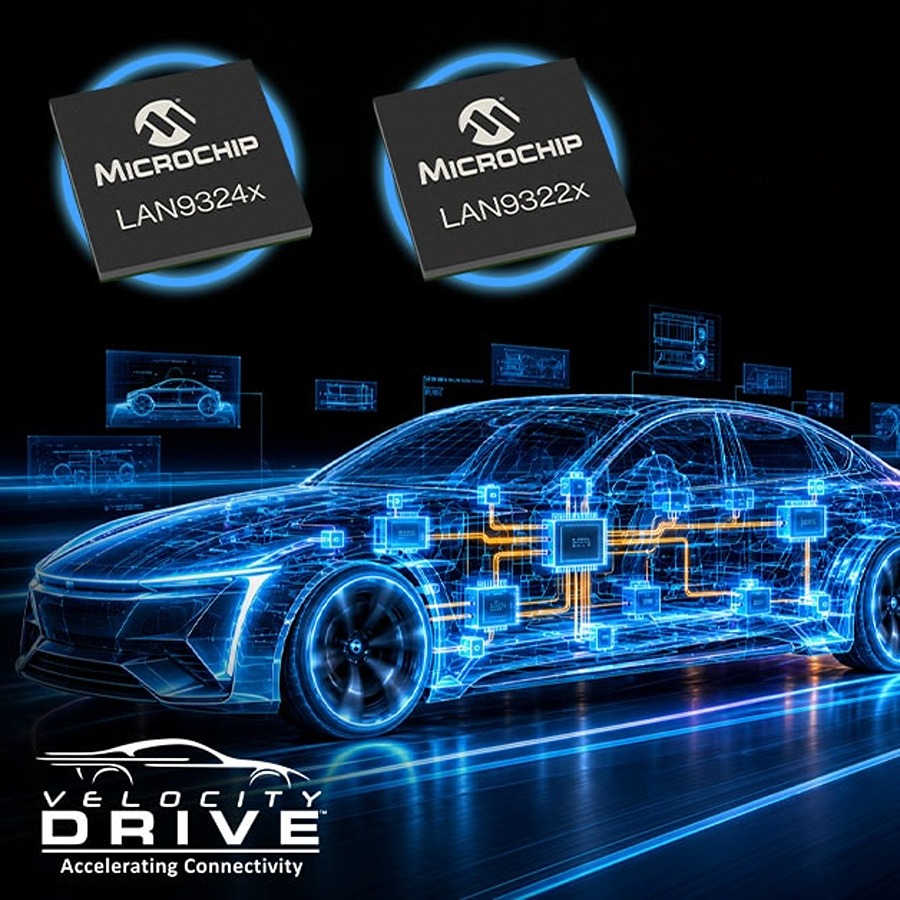
Key Takeaways
- Microchip’s LAN9322x & LAN9324x are automotive‑qualified Ethernet TSN switches designed for software‑defined, zonal vehicle networks.
- The LAN9322x family targets compact edge or zone‑controller modules (2‑4 ports, up to 1 Gbps per port).
- The LAN9324x family scales to higher‑performance gateways and central‑compute nodes (4‑8 ports, up to 10 Gbps per port).
- Both families ship with integrated 10BASE‑T1S, 100BASE‑T1, 1000BASE‑T1 PHYs and optional SerDes links, allowing a single‑chip solution for mixed‑speed topologies.
- VelocityDRIVE provides YANG‑based, standards‑compliant management, eliminating the need for custom switch firmware.
- Deterministic latency, functional safety (ISO 26262 compliance), and built‑in cybersecurity features meet the toughest automotive requirements.
Introduction: Why TSN Switches Matter for Modern Vehicles
As automotive electronics migrate from distributed ECUs to centralized compute platforms and zonal networking, the in‑vehicle network (IVN) must do more than move bits. It must react to changing bandwidth demands, guarantee sub‑microsecond latency, and preserve functional safety and security throughout the vehicle’s lifecycle. Time‑Sensitive Networking (TSN) delivers deterministic Ethernet performance, and Microchip’s latest LAN932x switch families aim to make TSN integration a “drop‑in” experience for OEMs and Tier‑1 suppliers.
Product Families Overview
LAN9322x – Compact, Edge‑Focused Switching
- Port count: 2 – 4 Ethernet ports (configurable mix).
- Speed options: Integrated 10BASE‑T1S (10 Mbps), 100BASE‑T1 (100 Mbps), 1000BASE‑T1 (1 Gbps).
- Form factor: 48‑lead QFN‑48 or 64‑lead QFN‑64, suitable for space‑constrained zone controllers.
- Target use‑cases: Sensor aggregation, ADAS edge compute, body‑control modules.
LAN9324x – High‑Throughput, Gateway‑Level Switching
- Port count: 4 – 8 Ethernet ports (mix of copper and fiber).
- Speed options: Same PHY suite as LAN9322x plus optional 10 Gbps SerDes lanes for back‑plane or fiber links.
- Form factor: 144‑lead BGA, supporting higher pin density and thermal dissipation.
- Target use‑cases: Central compute nodes, infotainment gateways, V2X communication hubs.
Both families share a common TSN‑aware MAC/PHY architecture, IEEE 802.1Qbv (time‑aware shaping), 802.1AS (gPTP), and 802.1Qci (per‑stream filtering). They are qualified to ISO 26262 ASIL‑B and support Secure Onboard Communication (SecOC) for cryptographic authentication.
Comparison at a Glance
| Feature | LAN9322x | LAN9324x |
|---|---|---|
| Maximum ports | 4 (mix of 10/100/1000 Mbps) | 8 (mix of 10/100/1000 Mbps + 10 Gbps SerDes) |
| Typical use | Edge/zone controllers | Central compute & gateway |
| Package | QFN‑48 / QFN‑64 | BGA‑144 |
| PHY integration | 10BASE‑T1S, 100BASE‑T1, 1000BASE‑T1 | Same + optional 10 Gbps SerDes |
| TSN support | 802.1Qbv, 802.1AS, 802.1Qci | Same + enhanced traffic shaping |
| Safety rating | ISO 26262 ASIL‑B | ISO 26262 ASIL‑B |
| Management stack | VelocityDRIVE (YANG/CORECONF) | VelocityDRIVE (YANG/CORECONF) |
| Power consumption | ≤ 1.2 W (typ.) | ≤ 2.5 W (typ.) |
Data derived from Microchip product briefs (2024‑2025).
VelocityDRIVE: Standards‑Based, Self‑Managed Control
Microchip bundles the switches with VelocityDRIVE, a software platform that leverages IETF/IEEE YANG data models and the CORECONF protocol. Engineers can:
- Configure port speeds, VLANs, and TSN schedules via a web UI or NETCONF client.
- Monitor real‑time latency, error counters, and link health without custom firmware.
- Update firmware or TSN schedules over‑the‑air (OTA) using secure TLS channels, preserving functional safety certification.
Because the management layer is device‑agnostic, a single configuration script can provision both LAN9322x and LAN9324x units, accelerating development cycles and reducing bill‑of‑materials (BOM) complexity.
Security and Functional Safety Features
- Secure Onboard Communication (SecOC) integration for message authentication.
- Hardware‑rooted key storage (eFuse) to protect cryptographic keys.
- Fail‑safe watchdog timers that default to a safe‑state if TSN timing deviates beyond tolerance (≤ 100 ns).
- Redundant port mapping for graceful degradation in the event of a link failure.
These capabilities align with the AUTOSAR Adaptive platform and support upcoming ISO 21434 cyber‑security standards.
Bottom Line
Microchip’s LAN9322x and LAN9324x TSN switch families provide a scalable, standards‑compliant foundation for the next wave of software‑defined vehicle architectures. By offering integrated PHY options from 10 Mbps to 10


