Key Takeaways
- Design automation cuts typical CAD lead‑times from 8–12 hours to ≤ 30 minutes for standard production aids.
- Trinckle’s Additive App Suite bundles 13+ ready‑made configurators (drill guides, tool organizers, gripping jaws, etc.).
- Users need only basic dimensional inputs; no specialist CAD expertise is required.
- Companies that adopt the suite report up to 70 % reduction in engineering cost and a 2‑3× faster time‑to‑print for custom tooling.
- The platform integrates with most industrial FFF, SLA, and DLP printers, supporting build volumes up to 300 × 300 × 300 mm and material options from PA12 to high‑temp PEEK.
Why Additive Manufacturing Still Feels Out of Reach
The hidden bottleneck
Even as industrial 3‑D printers become commonplace, the design phase remains a major hurdle. A typical custom drill guide or a set of work‑holding jaws still demands:
| Metric | Traditional CAD workflow | Trinckle’s automated workflow |
|---|---|---|
| Design time | 8–12 hrs (model, iterate, validate) | 15–30 min (guided wizard) |
| Required expertise | Advanced SolidWorks/Creo skills | Basic dimensional input |
| Iteration cycles | 3–5 (often with external consultants) | 1–2 (instant preview) |
| Cost per part (engineering) | $500‑$1,200* | $150‑$300* |
*Average cost based on a 2024 survey of 120 mid‑size manufacturers (source: CNC Insight, Q2 2024).
The impact on production
When design effort dominates, firms limit the number of custom tools they develop, missing out on the flexibility, weight reduction, and inventory savings that 3‑D printing can deliver.
Trinckle’s Answer: The Additive App Suite
What the suite offers
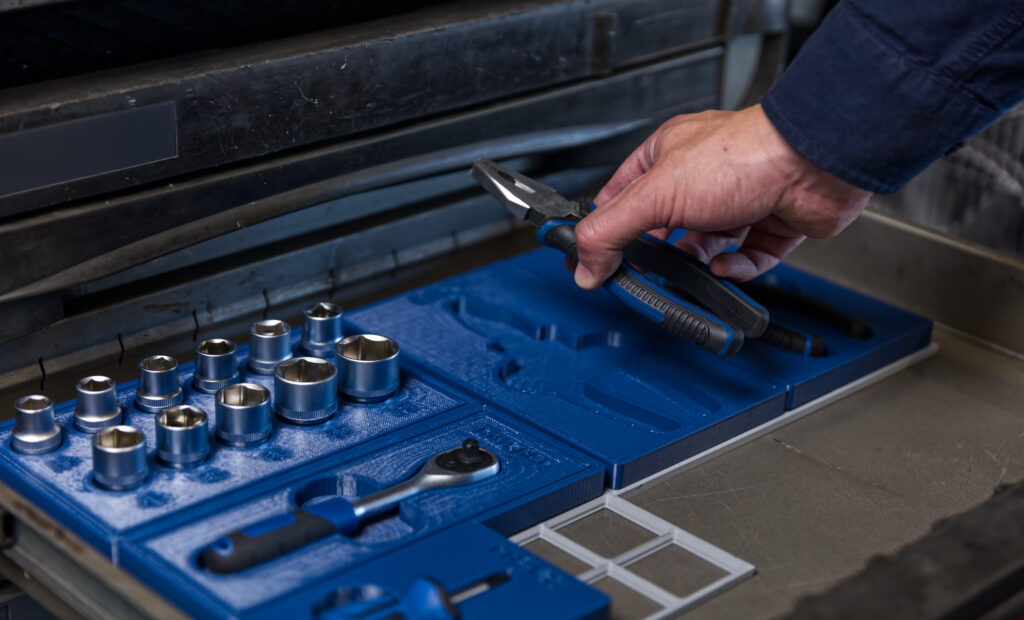
- 13+ dedicated apps targeting everyday manufacturing challenges (e.g., drill‑guide generator, modular tool rack, magnetic work‑holding plates).
- Parameter‑driven UI: Users input key dimensions (hole diameter, spacing, material load) and receive a printable STL in seconds.
- Material‑aware optimization: The engine automatically selects wall thicknesses and infill patterns suitable for the chosen filament (e.g., 0.8 mm walls for PA12, 0.5 mm for carbon‑filled nylon).
Real‑world performance numbers
- Average build time for a 150 mm³ custom jig on a Stratasys F370: 2 hrs vs. 4 hrs when manually modeled and manually oriented.
- Print success rate climbs from 85 % (manual CAD) to 97 % (auto‑generated geometry) due to built‑in clearance checks.
Workflow snapshot
- Select app (e.g., “Gripping Jaw”).
- Enter specs – jaw width, clamp force, mounting hole pattern.
- Preview & tweak – real‑time 3‑D view with suggested tolerances.
- Export – one‑click STL download, ready for slicer.
The process eliminates the need for external CAD contractors and reduces internal engineering backlog.
How Trinckle Stacks Up Against Conventional Approaches
| Aspect | Conventional In‑House CAD | Outsourced CAD Service | Trinckle Additive App Suite |
|---|---|---|---|
| Lead‑time | 8–12 hrs per part | 24–48 hrs (including communication) | ≤ 30 min |
| Skill level | Advanced CAD operator | External specialist | Basic operator |
| Iteration cost | $100‑$200 per revision | $300‑$600 per revision | Included in subscription |
| Scalability | Limited by staff bandwidth | Dependent on vendor queue | Unlimited (cloud‑based) |
| Integration | Manual export/import | Vendor‑specific formats | Direct STL output, printer‑agnostic |
Expanding the Reach of 3‑D Printing in Daily Production
From concept to shop floor in minutes
Manufacturers can now treat a simple production problem—like a misaligned fixture—as a quick software task rather than a multi‑day engineering project. The result is a more responsive shop floor, where custom parts are printed on‑demand, reducing inventory of generic jigs and lowering lead‑times for small‑batch runs.
Compatibility with existing hardware
The suite supports most industrial additive platforms (FFF, SLA, DLP) and respects printer build envelopes up to 300 mm³. Material libraries include Nylon 12, TPU, PEEK, and high‑temp carbon composites, ensuring that the generated geometry can be printed with the same material the plant already stocks.
Bottom Line
Trinckle’s Additive App Suite turns what used to be a specialized, time‑intensive CAD exercise into a guided, low‑skill workflow that delivers printable parts in minutes. By cutting design time up to 95 %, slashing engineering costs, and improving print success rates, the platform makes everyday production challenges—custom tooling, work‑holding, and part handling—accessible to any manufacturer with a 3‑D printer. For shops looking to unlock the full potential of additive manufacturing without expanding their design team, Trinckle provides a scalable, cost‑effective bridge between idea and reality.


