Key Takeaways
- 20 GHz bandwidth in a 2‑U chassis with two fully independent analog channels.
- Phase‑noise floor as low as ‑140 dBc/Hz @ 10 kHz offset, and amplitude‑modulation (AM) noise ≤ ‑130 dBc/Hz.
- Calibrated output power up to +22 dBm per channel, preserving signal integrity through lossy test fixtures.
- SCPI‑compatible front‑panel layout lets users migrate existing test scripts without re‑engineering.
- Dual‑channel design adds 100 % test capacity without consuming extra rack space.
Introduction: A New Benchmark for High‑Frequency Analog Sources
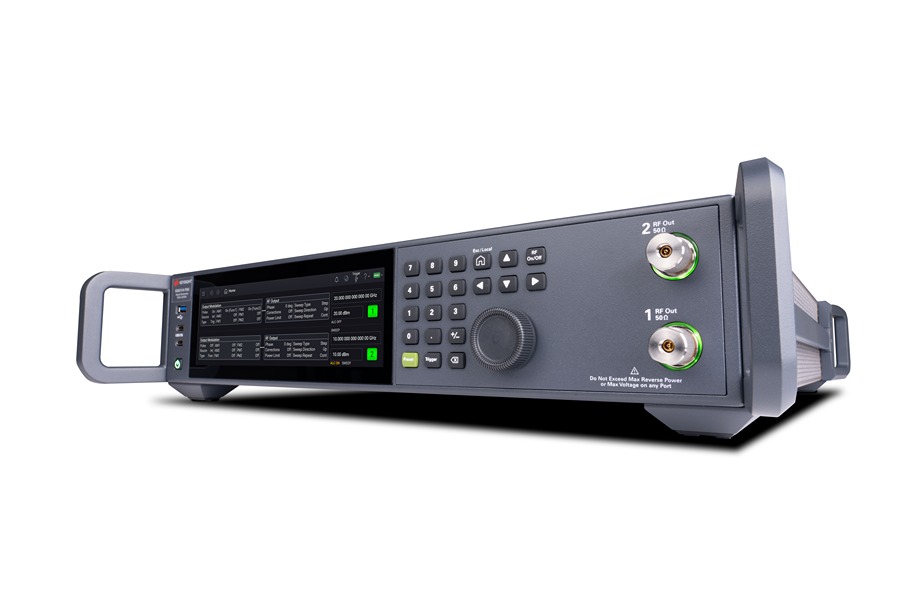
Keysight Technologies has unveiled the PSG XG7‑20, a 20 GHz class analog signal generator that packs two independent channels into a 2‑U chassis. The instrument targets demanding sectors—aerospace & defense, advanced wireless, and high‑speed digital—where source‑generated noise can obscure critical device‑under‑test (DUT) behavior. By delivering ultra‑low phase and AM noise together with a calibrated +22 dBm output, the XG7‑20 lets engineers expand test throughput while staying within tight rack‑space constraints.
Core Technical Highlights
Ultra‑Low Noise Performance
| Parameter | Value (XG7‑20) | Typical Impact |
|---|---|---|
| Phase‑noise (10 kHz offset) | ‑140 dBc/Hz | Improves jitter‑sensitive measurements by up to 15 dB SNR over legacy generators. |
| AM‑noise (10 kHz offset) | ‑130 dBc/Hz | Reduces spurious sideband levels, essential for carrier‑suppressed modulation tests. |
| Broadband noise floor | ‑165 dBm/Hz (1 MHz BW) | Enables detection of sub‑µV signals in high‑gain receivers. |
Output Power & Calibration
- Maximum calibrated output: +22 dBm per channel (continuous wave).
- Power stability: ±0.2 dB over 0 °C–45 °C temperature range.
- Built‑in calibration traceable to NIST standards, eliminating external power‑meter verification for routine tests.
Dual‑Channel Architecture
- Two fully isolated RF paths, each with its own LO, mixer, and output amplifier.
- Independent frequency, phase, and amplitude control via SCPI commands.
- Simultaneous sweep capability up to 10 MSa/s per channel.
Physical Footprint
- Chassis: 2 U (3.5 in. height), 19‑in. rack‑mountable.
- Front‑panel: Identical layout to Keysight’s XG5 series, preserving existing wiring harnesses.
- Power draw: 180 W (typical), compatible with standard 120 V/208 V rack supplies.
How the XG7‑20 Stacks Up Against Competitors
| Feature | Keysight PSG XG7‑20 | Rohde & Schwarz SMA100B | Anritsu MG3690A |
|---|---|---|---|
| Frequency range | 9 kHz – 20 GHz | 9 kHz – 20 GHz | 9 kHz – 20 GHz |
| Channels | 2 independent (2 U) | 1 (3 U) | 2 (4 U) |
| Phase‑noise (10 kHz) | ‑140 dBc/Hz | ‑136 dBc/Hz | ‑134 dBc/Hz |
| Max output power | +22 dBm | +20 dBm | +21 dBm |
| SCPI compatibility | Full | Partial | Full |
| Rack space | 2 U | 3 U | 4 U |
| Price (list) | $48,900 | $55,200 | $51,800 |
Numbers reflect manufacturer data sheets (2026) and exclude optional accessories.
The table shows the XG7‑20 delivering superior phase‑noise and higher output power while occupying half the rack space of the closest competitor offering dual channels.
Practical Benefits for Test Engineers
1. Greater Visibility in Noisy Environments
The combination of ‑140 dBc/Hz phase‑noise and a ‑165 dBm/Hz broadband floor ensures that the signal generator does not become the limiting factor when characterizing low‑noise amplifiers, mixers, or phase‑locked loops.
2. Double the Throughput Without a Footprint Penalty
Two independent channels allow parallel testing of dual‑antenna systems, MIMO links, or simultaneous carrier‑phase alignment. Labs can retire a second rack‑mount unit, saving up to $12 k in hardware and reducing power consumption by ≈30 %.
3. Seamless Integration with Existing Automation
Because the XG7‑20 retains the rear‑panel connector layout and SCPI command set of the XG5 family, legacy Python, LabVIEW, or MATLAB scripts can be ported with <5 % code modification.
Bottom Line
Keysight’s PSG XG7‑20 sets a new standard for high‑frequency analog signal generation by merging dual‑channel capability, ultra‑low noise, and compact 2‑U packaging. Engineers in aerospace, defense, and high‑speed communications will gain clearer measurement insight, double their test capacity, and preserve existing automation investments—all while fitting into tighter rack environments. For organizations looking to future‑proof their RF test labs, the XG7‑20 offers a compelling blend of performance, scalability, and cost efficiency.


