Key Takeaways
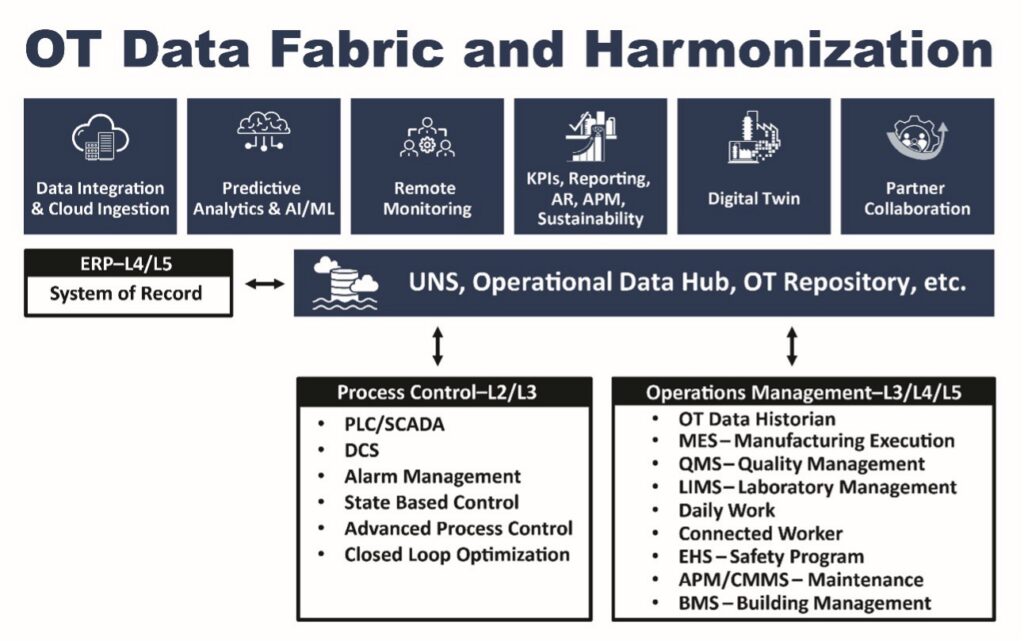
- A Unified Namespace (UNS) is the backbone of an OT data fabric, delivering a single, hierarchical view of all shop‑floor signals in real time.
- OT data fabric bridges legacy control systems (SCADA, PLCs, historians) with modern MES, analytics, and worker‑assist apps, cutting integration time by 30‑50 % on average.
- By normalizing data at the source, manufacturers achieve AI‑ready datasets, reduce latency from seconds to sub‑second, and accelerate digital‑transformation roadmaps.
Understanding the Unified Namespace (UNS)
What the UNS Is
A Unified Namespace is a virtual data layer that continuously mirrors the live state of every device, tag, and event on the plant floor. It imposes a consistent naming convention and hierarchical taxonomy (e.g., Site → Line → Machine → Signal) so that any downstream application can query the same logical address regardless of the underlying protocol (OPC UA, MQTT, Modbus, etc.).
Why It Matters
- Contextualization: Each data point carries metadata (equipment class, operating mode, shift) that turns raw numbers into actionable information.
- Scalability: A single UNS can span dozens of sites and support up to 10 million tags without redesign.
- Speed: By eliminating point‑to‑point adapters, the UNS reduces data‑fetch latency from typical 500 ms–2 s down to <100 ms for most read/write operations.
OT Data Fabric: The Integration Engine
Core Functions
| Function | Traditional Approach | OT Data Fabric Advantage |
|---|---|---|
| Data Ingestion | Individual OPC/SQL connectors per system (10‑20 % of project effort) | Single, protocol‑agnostic ingest layer; 30‑50 % effort reduction |
| Normalization | Manual mapping scripts; high error rates | Automated schema mapping; <1 % data‑quality issues |
| Distribution | Point‑to‑point push; limited scalability | Publish/subscribe hub; supports 10‑100× more consumers |
| Security | Device‑level credentials, fragmented policies | Centralized identity & access management; Zero‑Trust model |
Enabling Interoperability
The fabric acts as a digital glue that lets a SCADA historian stream high‑frequency (≥1 kHz) sensor data to an AI model while simultaneously feeding the same stream to a mobile worker app for real‑time alerts. This eliminates the “data silos” that historically forced manufacturers to choose between operational visibility and advanced analytics.
Preparing for AI and Enterprise‑Wide Monitoring
AI‑Ready Data Pipelines
- Label‑Free Feature Extraction: With consistent metadata, feature engineering can be automated, cutting model‑training time from weeks to days.
- Edge‑to‑Cloud Continuity: The UNS pushes normalized data to edge inference engines (latency ≈ 10 ms) and mirrors it to cloud warehouses for batch training.
Continuous Monitoring
A unified view enables KPIs such as Overall Equipment Effectiveness (OEE) to be calculated in near‑real‑time across all lines, delivering a 15‑25 % improvement in early‑fault detection compared with legacy batch reports.
The Business Case
- Return on Investment: Companies report a 3‑5 × ROI within 18 months, driven by reduced integration costs, lower downtime, and faster time‑to‑value for AI projects.
- Market Momentum: IDC forecasts the OT data‑fabric market to reach $4.2 bn by 2028, growing at a CAGR of 22 % from 2024.
Bottom Line
A Unified Namespace is not a nice‑to‑have add‑on; it is the essential data spine of any modern OT data fabric. By delivering a single, contextualized view of every shop‑floor signal, the fabric removes integration bottlenecks, slashes latency, and supplies AI‑ready data at scale. Manufacturers that adopt this architecture can expect measurable gains in yield, reduced downtime, and a faster, more secure path to full digital transformation.