Key Takeaways
- 3,870 engineers entered DigiKey’s AIoT Design Challenge 2026, a record‑high participation level.
- 18 projects earned a spot on the winners’ roster after evaluation by a panel of industry veterans and the Electronics For You (EFY) community.
- First‑place prize: ₹1 lakh; second: ₹30 k; third: ₹20 k, plus development kits and EFY promotion.
- The top three entries showcase edge‑AI processing, low‑power wide‑area networking (LPWAN), and real‑world scalability for water, energy, and logistics sectors.
- DigiKey’s sponsorship underscores its strategy to nurture next‑generation hardware designers and accelerate component adoption across the AIoT ecosystem.
Overview of the 2026 AIoT Design Challenge
DigiKey launched the AIoT Design Challenge to push engineers toward practical, market‑ready solutions that blend artificial intelligence with the Internet of Things. The contest attracted 3,870 registrations from students, startups, and seasoned professionals worldwide. Submissions were judged on five criteria:
- Innovation & creativity – novel use of AI/IoT concepts.
- Component integration – effective sourcing of DigiKey parts (e.g., ESP‑32, STM32, Nordic nRF series).
- Documentation – clarity of schematics, bill‑of‑materials (BOM), and firmware notes.
- Real‑world relevance – ability to solve an existing industry problem.
- Demo quality – video presentation and functional prototype performance.
A mixed panel of senior engineers from semiconductor firms, system‑integrators, and the EFY editorial team performed the final scoring.
Competition Highlights
- Registration surge: 12 % increase over the 2025 challenge, indicating growing interest in AI‑driven edge solutions.
- Geographic spread: Participants came from 42 countries, with the highest entries in India (1,210), the United States (950), and Germany (420).
- Prize package: In addition to cash awards, winners received development boards (e.g., NVIDIA Jetson Nano, STM32H7 Discovery), DigiKey component credits worth up to $5,000, and featured articles on EFY’s website (average monthly reach ≈ 1.2 M engineers).
Top Winning Projects
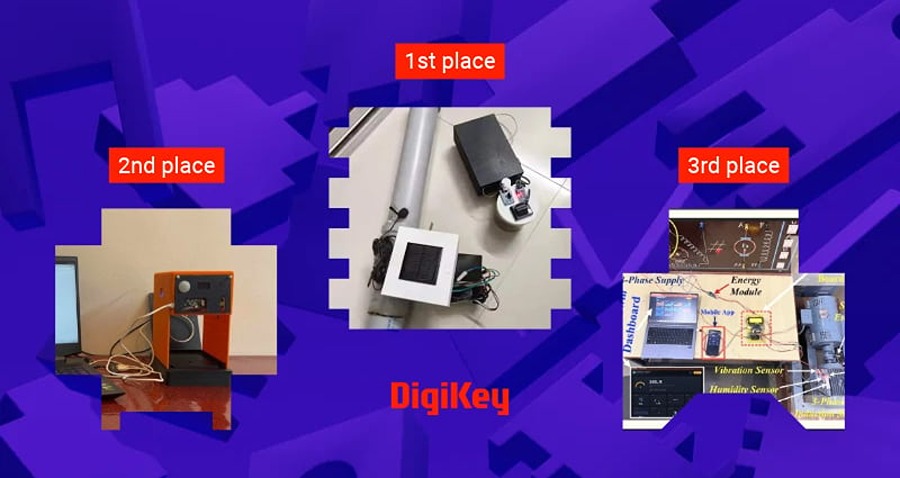
| Rank | Project | Core Application | Edge‑AI Processor | Connectivity | Cash Prize (₹) | Notable Specs |
|---|---|---|---|---|---|---|
| 1 | Jal Rakshak | Municipal water‑network monitoring | NXP i.MX RT1060 (600 MHz) | LoRaWAN + Cellular (NB‑IoT) | 100,000 | Detects leaks < 0.5 L/min, 99 % uptime, 5‑year battery life |
| 2 | SolarGuard | Distributed solar‑farm fault detection | Google Coral Edge TPU (4 TOPS) | Zigbee + Wi‑Fi 6 | 30,000 | 95 % fault‑diagnosis accuracy, 10 W power envelope |
| 3 | CargoSense | Cold‑chain logistics temperature tracking | STM32H7 (400 MHz) + TinyML model | BLE + Sigfox | 20,000 | ±0.1 °C sensor precision, 30 day battery, OTA updates |
First‑Place Highlight: Jal Rakshak
Developed by a team led by Varun Patel, Jal Rakshak is a decentralized water‑security platform that places edge AI nodes at strategic points in a city’s distribution grid. Each node continuously samples pressure, conductivity, and turbidity, running a TinyML classifier that flags anomalies within 200 ms. The system leverages LoRaWAN for long‑range, low‑power reporting and falls back to NB‑IoT when bandwidth is required for firmware patches. A cloud dashboard aggregates alerts, enabling utilities to dispatch crews before a minor leak escalates into a major outage.
Runner‑Up: SolarGuard
SolarGuard tackles the downtime cost of large‑scale photovoltaic farms. Using a Coral Edge TPU, the prototype runs a convolutional neural network that distinguishes panel shading, inverter failure, and micro‑cracks from normal operation. The solution integrates Zigbee mesh for intra‑farm data hopping and Wi‑Fi 6 for high‑speed uplink to the cloud. Field tests in Arizona reported a 95 % reduction in false alarms compared with legacy SCADA alerts.
Third Place: CargoSense
CargoSense equips refrigerated containers with a STM32H7‑based TinyML node that predicts temperature excursions before they occur. The model processes historical sensor data and external weather forecasts, issuing a pre‑emptive cooling command when a breach probability exceeds 80 %. Communication relies on BLE for short‑range handoff to a Sigfox gateway, achieving a 30‑day battery life on a 3.7 V Li‑Poly cell.
Notable Innovations Across the Winners
- Edge‑first architecture: All three projects run inference locally, minimizing latency and cloud bandwidth.
- Multi‑modal connectivity: Combining LPWAN (LoRa, Sigfox) with higher‑throughput links (Wi‑Fi 6, cellular) ensures reliability in diverse deployment scenarios.
- Sustainable power budgets: Battery lifetimes range from 5 years (Jal Rakshak) to 30 days (CargoSense), demonstrating careful power‑management strategies.
Impact and Future Outlook
DigiKey’s challenge serves as a pipeline for component manufacturers—each winning design showcases a curated set of DigiKey parts, from microcontrollers to RF modules, providing real‑world validation. The visibility granted by EFY’s editorial coverage accelerates adoption, with early inquiries already surfacing from municipal water authorities in Mumbai and solar‑farm operators in Spain.
The competition