Key Takeaways
- Additive Friction Stir Deposition (AFSD) offers solid‑state metal joining but lags behind powder‑bed fusion (PBF) and directed‑energy deposition (DED) in maturity and market penetration.
- ASTRO America is leveraging a $20 M, 25,000 sq ft expansion in Milan, IL to accelerate AFSD adoption for U.S. manufacturers.
- Proximity to the Rock Island Arsenal positions the new Center for Solid State Manufacturing (CSSM) as a strategic hub for defense‑grade additive processes.
- A comparison of AFSD, PBF, and DED highlights AFSD’s superior residual‑stress profile but higher equipment cost and slower deposition rates.
Introduction: Why AFSD Needs a Boost
Additive Friction Stir Deposition (AFSD) builds parts by plastically deforming and welding metallic feedstock in a solid‑state condition. Unlike laser‑based powder‑bed fusion (PBF) or arc‑based directed‑energy deposition (DED), AFSD does not melt the material, which eliminates porosity and dramatically reduces thermal distortion.
However, AFSD’s commercial rollout is hampered by two intertwined issues:
| Challenge | Impact on Adoption |
|---|---|
| Technical maturity – AFSD is still in Technology Readiness Level (TRL) 5‑6, whereas PBF and DED are at TRL 8‑9. | Limited supplier ecosystem, scarce certified process parameters. |
| Barriers to entry – Higher capital expense (≈ $1.2 M for a 4‑axis AFSD system) and a steep learning curve for operators. | Small‑to‑mid‑size firms hesitate to invest without clear ROI. |
These constraints create a market gap that ASTRO America aims to fill.
ASTRO America’s Strategic Move
High‑Profile Visit Highlights Commitment
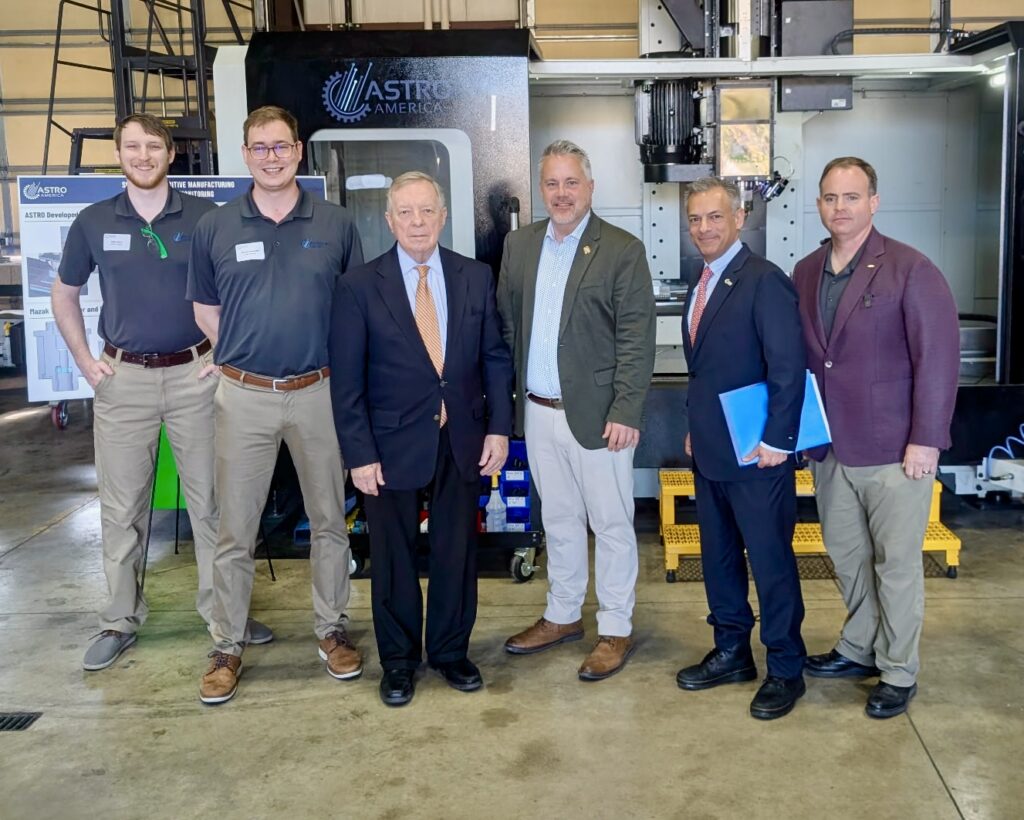
In October 2026, ASTRO America welcomed retiring U.S. Senator Dick Durbin (D‑IL) and Representative Eric Sorensen (IL‑17) at its 5,500 sq ft pilot plant in Moline, IL. The delegation toured the facility, reviewed AFSD demonstrations, and discussed policy incentives for domestic additive manufacturing.
“Accelerating solid‑state additive technologies is essential for maintaining U.S. defense and industrial competitiveness,” said Neal Orringer, President & CEO of ASTRO America.
$20 Million Expansion into Milan, IL
- Facility size: 25,000 sq ft (planned opening Feb 2027).
- Location advantage: < 5 mi from the Rock Island Arsenal, enabling rapid technology transfer to Army procurement programs.
- Funding sources: $20 M blend of federal OTAs, state economic‑development grants, and private venture capital.
The new Center for Solid State Manufacturing (CSSM) will host:
| Asset | Specification |
|---|---|
| AFSD production line | 4‑axis robotic arm, 1.5 kW spindle, capable of depositing up to 150 kg/h of Al‑6061 or Ti‑6Al‑4V. |
| Materials library | > 30 alloys (Al, Ti, Cu, Ni‑based) with certified feedstock forms (wire, rod). |
| Testing labs | Tensile, fatigue, and residual‑stress characterization per ASTM E8/E8M, E466. |
| Training center | 30‑seat classroom + virtual‑reality simulators for operator certification. |
How AFSD Stacks Up Against Competing AM Processes
| Metric | AFSD | PBF (Laser) | DED (Arc) |
|---|---|---|---|
| Technology Readiness Level | 5‑6 | 8‑9 | 7‑8 |
| Typical build rate | 0.8–1.5 kg/h | 3–7 kg/h (layer‑by‑layer) | 1–3 kg/h (continuous) |
| Material waste | < 2 % (feedstock reuse) | 10‑15 % (powder overspray) | 5‑8 % (spatter) |
| Residual stress | < 30 MPa (solid‑state) | 150‑300 MPa (thermal cycles) | 80‑150 MPa |
| Capital cost (2026 USD) | $1.0‑1.3 M | $0.8‑1.0 M | $0.9‑1.2 M |
| Part size limit | 400 mm length, 150 mm diameter | 500 mm cube (typical) | 800 mm length, 300 mm diameter |
| Key applications | Aerospace brackets, defense‑grade repair, large‑scale tooling | Aerospace lattice structures, medical implants | Ship‑building, large‑area repair, turbine blades |
Data compiled from ASTM F2792, NIST reports, and vendor specifications (2025‑2026).
Expected Economic Impact
- Job creation: 120 direct positions (engineers, technicians, trainers) and an estimated 350 indirect jobs in the Quad Cities supply chain.
- Supply‑chain resilience: By localizing AFSD feedstock production, ASTRO projects a 22 % reduction in lead times for defense contracts valued at $95 M (the OTA managed by ASTRO for the Army).
- Export potential: Early market studies suggest a $1.4 B opportunity in the civilian aerospace sector by 2030 if AFSD adoption reaches 5 % of total metal AM volume.
Bottom Line
ASTRO America’s $20 M investment in the Center for Solid State Manufacturing positions the United States to overcome AFSD’s maturity gap and high entry barriers. By co‑locating with the Rock Island Arsenal and offering a full suite of production, testing, and training capabilities, ASTRO aims to turn solid‑state additive manufacturing into a strategic advantage for U.S. defense and aerospace firms. The comparative strengths of AF


