Key Takeaways
- ASTRO America hat ein $9 million CRADA mit dem U.S. Air Force Research Laboratory (AFRL) unterzeichnet, um die additive Fertigung (AM) der Gray Wolf Cruise-Missile-Familie zu beschleunigen.
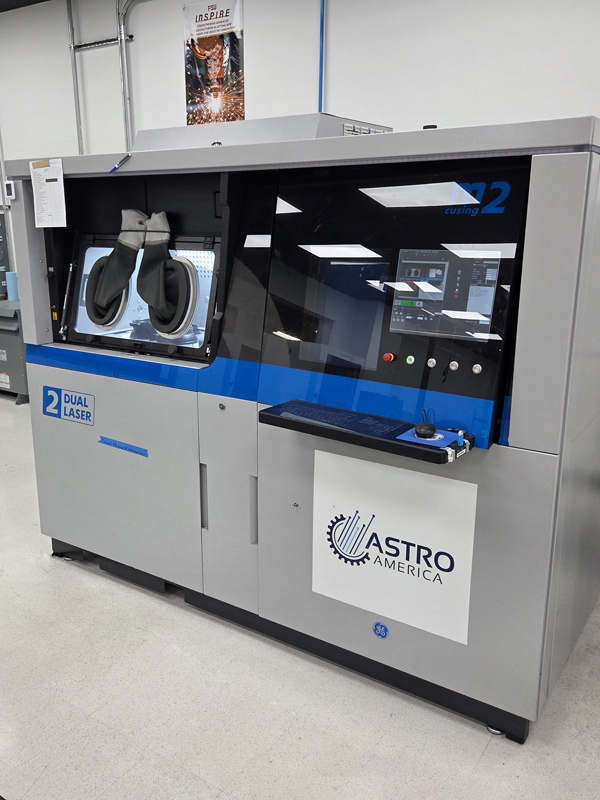
- Die Partnerschaft schafft das DART (Design for Affordable and Rapid Throughput) Hub in der Nähe von Eglin AFB, FL, das Metall-Laser-Powder-Bed-Fusion, Binder-Jet, Directed-Energy-Deposition und konventionelles Gießen/Fräsen kombiniert.
- Northrop Grumman, Florida State University’s InSPIRE und ASTRO’s AM Forward Compact teilen Einrichtungen, geistige Eigentumsrechte und Testdaten, was schnelles Prototyping und kostengünstige Produktion ermöglicht.
- Frühziele umfassen eine 30 % Reduzierung der Teilkosten pro Missile und eine 50 % Verkürzung der Durchlaufzeit gegenüber herkömmlichen rein mechanischen Methoden.
- Der CRADA-Rahmen öffnet zudem die Tür für zukünftige verteidigungsbezogene AM-Projekte und bietet ein wiederholbares Modell für öffentlich-private F&E-Zusammenarbeit.
Overview of the New CRADA
ASTRO America, der gemeinnützige Verwalter des AM Forward Compact, hat ein Cooperative Research and Development Agreement (CRADA) mit dem Air Force Research Laboratory (AFRL) geschlossen. Die gemeinsame Anstrengung wird mit nahezu $9 million aus kombinierter Regierungs-Industrie-Investition finanziert und zielt auf die schnelle, kostengünstige Produktion von Northrop Grummans Gray Wolf Cruise-Missile-Design ab.
Das Abkommen folgt einem wachsenden Trend im Verteidigungssektor, bei dem CRADAs genutzt werden, um Ressourcen zu bündeln, geistiges Eigentum (IP) zu teilen und den Technologietransfer vom Labor zum Schlachtfeld zu beschleunigen.
What Makes a CRADA Different?
| Aspect | Traditional Procurement Contract | CRADA (Public-Private) |
|---|---|---|
| Funding | Fixed-price or cost-plus, fully government-funded | Shared investment (e.g., $9 M split between AFRL and partners) |
| IP Ownership | Government retains rights; limited commercial use | Joint IP rights; partners can file patents on R&D outcomes |
| Risk Allocation | Primarily on contractor | Risks shared; government provides facilities, partners provide expertise |
| Speed to Market | Often longer due to procurement cycles | Faster because of collaborative R&D and shared facilities |
Participants and Their Roles
| Partner | Core Contribution |
|---|---|
| ASTRO America | Manages the AM Forward Compact, provides project oversight, and coordinates IP sharing |
| AFRL | Supplies test ranges, validation expertise, and a portion of the $9 M budget |
| Northrop Grumman | Supplies the Gray Wolf design specifications and defines performance targets |
| FSU InSPIRE | Delivers academic research, simulation tools, and workforce training |
| Eglin AFB Site | Hosts the new DART manufacturing R&D hub, offering secure access to flight-test data |
DART: Design for Affordable and Rapid Throughput
The DART initiative is the operational core of the CRADA. It establishes a dedicated manufacturing laboratory within 5 km of Eglin AFB, where multiple AM processes are evaluated side-by-side:
| Process | Typical Build Rate | Material Palette | Expected Cost Savings |
|---|---|---|---|
| Laser Powder-Bed Fusion (LPBF) | 0.5 kg h⁻¹ | Ti-6Al-4V, Inconel 718 | 25 % vs. CNC machining |
| Binder-Jetting (BJ) | 1.2 kg h⁻¹ | Al-Si10Mg, Cu-Cr | 30 % vs. investment casting |
| Directed-Energy Deposition (DED) | 0.8 kg h⁻¹ | Maraging steel, tungsten | 20 % vs. forged parts |
| Conventional Casting & CNC Machining | — | High-strength steels | Baseline for comparison |
By running these technologies concurrently, DART can pinpoint the optimum process for each missile sub-assembly—whether it’s a high-temperature turbine blade (LPBF) or a large structural bulkhead (BJ + post-machining).
Direct Impact on the Gray Wolf Missile
The Gray Wolf program, initiated roughly 10 years ago, seeks a low-cost, high-volume cruise missile capable of swarming enemy defenses. Current production relies heavily on subtractive machining, which drives part counts to ≈ 150 per missile and unit costs above $150 k.
Projected DART outcomes:
- Part count reduction to ≈ 80 by consolidating assemblies through AM.
- Per-missile material cost cut from $150 k to ≈ $105 k (≈ 30 % saving).
- Lead time from design-to-first-article shortened from 18 months to ≈ 9 months.
These improvements align with the Air Force’s “Affordable Precision Strike” directive, which calls for missiles under $100 k in high-volume production.
Timeline and Milestones
| Milestone | Target Date |
|---|---|
| Facility construction at Eglin AFB | Q2 2025 |
| First AM-produced Gray Wolf component | Q4 2025 |
| Full-scale flight-test of AM-integrated missile | Q2 2026 |
| Production-line hand-off to Northrop Grumman | Q4 2026 |
Bottom Line
ASTRO America’s $9 million CRADA with AFRL represents a pivotal shift toward collaborative, cost-focused additive manufacturing for defense hardware. By consolidating cutting-edge AM processes at the DART hub, the partnership aims to slash Gray Wolf missile costs by 30 % and halve development lead times, while granting participating firms joint IP rights that can fuel future defense innovations. If the program meets its aggressive schedule, it


