Key Takeaways
- AMCRC commands A$57 million in federal funding, supporting 70 industry partners and 12 universities.
- The 2026 Additive Manufacturing Forum attracted ~200 delegates and showcased projects ranging from wear‑resistant coatings to titanium powder production.
- Additive‑manufacturing capabilities are being positioned as a strategic response to Australia’s submarine acquisition program and the broader decline in traditional manufacturing.
- Collaboration between research institutions (e.g., Adelaide University) and commercial firms (e.g., Fusetec 3D) is accelerating the rollout of clinical‑grade dental models and high‑performance metal parts.
Introduction: Why Additive Manufacturing Matters for Australia
Australia is at a crossroads. While the nation commits A$12 billion to the US‑built Attack Submarine program, its legacy manufacturing base—particularly the automotive sector—has been shrinking for over a decade. Additive manufacturing (AM) offers a way to re‑skill the workforce, shorten supply chains, and produce high‑value components locally. The Additive Manufacturing Cooperative Research Centre (AMCRC) sits at the heart of this transition.
AMCRC at a Glance
| Metric | Figure | Context |
|---|---|---|
| Total government funding | A$57 million (2021‑2026) | Distributed across research, prototyping, and industry‑uptake grants |
| Industry partners | 70 | Includes aerospace, medical, defense, and mining firms |
| University collaborators | 12 | Major campuses: Adelaide, Queensland, RMIT, Swinburne |
| Core projects funded (Year 1) | 5 | Wear‑resistant coatings, titanium powder, dental replicas, etc. |
| Forum attendance (2026) | ~200 | Engineers, OEMs, investors, and policy makers |
Source: AMCRC annual report (2024) and 2026 Forum press release.
Highlights from the 2026 Additive Manufacturing Forum
Venue & Audience Engagement
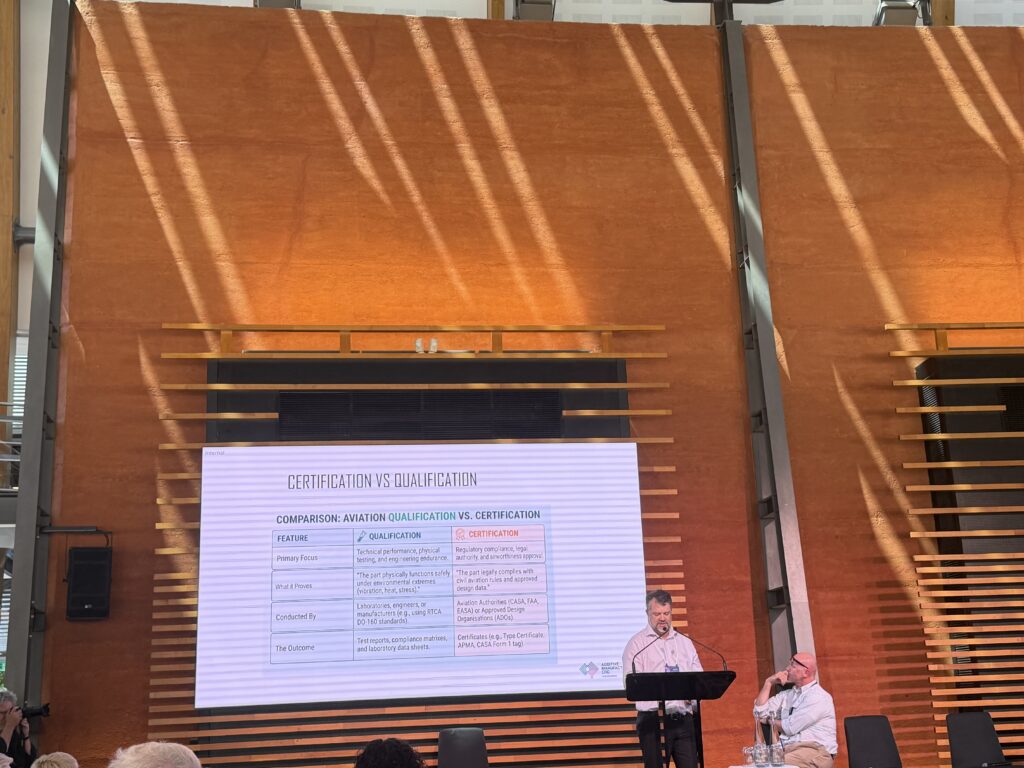
- Held at the National Wine Centre, Adelaide, a venue praised for its acoustics and networking spaces.
- Attendees reported a 90 % satisfaction rate in post‑event surveys, citing “practical demonstrations” and “real‑world case studies” as top draws.
Program Milestones Presented
| Project | Technology | Current Status | Anticipated Impact |
|---|---|---|---|
| Wear‑Resistant Coatings | Laser cladding of Cr‑Mo alloys | Prototype phase; 30 % wear reduction vs. conventional steel | Extends life of mining drill bits, saving ~A$4 M/yr |
| Titanium Powder Production | Plasma atomisation, closed‑loop recycling | Pilot plant delivering 1 kg/day of aerospace‑grade Ti‑6Al‑4V | Enables domestic supply for submarine components |
| Dental Anatomical Replicas | Stratasys J750 multi‑material printing | 150+ models delivered to dental schools | Improves training outcomes, reduces cadaver use by 80 % |
| Metallic Lattice Structures | Electron Beam Melting (EBM) | Small‑scale validation for lightweight hull brackets | Potential weight savings of 15 % for submarine modules |
Keynote Insights (Delivered by the Author)
- Historical resilience: The De Havilland Mosquito’s rapid wartime production illustrated the power of distributed manufacturing—a lesson for today’s networked AM nodes.
- Strategic alignment: Finnish “Motti” ambush tactics were used as a metaphor for small, agile production cells that can outmaneuver larger, centralized factories.
- Future outlook: Emphasised the need for policy incentives, skills training, and data‑driven supply‑chain visibility to fully realize AM’s potential in defense and civilian markets.
How AMCRC Stacks Up Against Other Australian CRCs
| CRC | Funding (2022‑2027) | Number of Partners | Primary Focus | Notable Output |
|---|---|---|---|---|
| AMCRC | A$57 M | 70 | Additive manufacturing across sectors | First domestic titanium powder plant |
| Advanced Manufacturing CRC | A$45 M | 55 | Robotics, AI, smart factories | 120 % increase in factory automation adoption |
| Materials Science CRC | A$38 M | 48 | Advanced composites, ceramics | 30 patented composite formulations |
The comparison underscores AMCRC’s leading role in metal AM and medical‑grade printing.
Implications for Australia’s Industrial Future
- Defense Readiness – Local AM of titanium and high‑strength alloys reduces reliance on overseas suppliers for critical submarine components.
- Job Creation – Each core project is projected to generate 15–25 skilled positions annually, supporting the nation’s Skills for Industry agenda.
- Export Potential – With a nascent domestic supply chain, Australia could export custom medical models and aerospace‑grade metal powders to the Asia‑Pacific region, tapping an estimated A$200 M market by 2030.
Bottom Line
The AMCRC’s 2026 Additive Manufacturing Forum highlighted a pivotal moment: government backing, industry collaboration, and cutting‑edge research are converging to revive Australia’s manufacturing base. By leveraging A$57 million in funding to deliver tangible projects—ranging from wear‑resistant coatings to titanium powder production—the Centre is positioning additive manufacturing as a cornerstone of national defense, healthcare, and export strategy. For Australia to capitalize on this momentum, sustained policy support, workforce upskilling, and broader industry adoption will be essential.


