Key Takeaways
- Siemens, HyperLynx paketine ek olarak yüksek hızlı doğrulama görevlerini otomatikleştiren AI-destekli HyperLynx Agentic Toolkit’i tanıttı.
- Araç seti 112 Gb/s ve 224 Gb/s seri bağlantıları destekler, modern tasarımların daha dar zaman marjları ve artan kart-seviye değişkenlerini yönetir.
- Doğal dil hedef belirleme, mühendislerin simülasyonları başlatmasını, parametreleri çıkarmasını ve SI/PI spesifikasyonlarına karşı sonuçları manuel betik yazmadan karşılaştırmasını sağlar.
- Erken aşama AI analizi, geç döngüdeki yeniden işleme süresini azaltarak geleneksel iş akışlarına göre doğrulama süresini %30-40 oranında kısaltabilir.
- Siemens, domain-specific agentic AI stratejisini Questa One Toolkit’ten daha geniş bir EDA alanına genişletiyor.
Siemens’ New AI Layer for HyperLynx
Siemens, mevcut HyperLynx sinyal ve güç-bütünlüğü platformuna bağlanan bir agentic-AI modülü olan HyperLynx Agentic Toolkit’i piyasaya sürdü. Araç seti, SerDes, DDR, sinyal bütünlüğü (SI) ve güç bütünlüğü (PI) gibi belirli bir alana göre ayarlanmış birkaç uzman AI ajanını bir araya getirir. Bir orkestrasyon ajanı, doğal dil doğrulama hedeflerini (ör. “224 Gb/s PAM-4 için göz-yüksekliği marjını doğrula”) yorumlar ve ilgili uzman ajanları fizik-tabanlı simülasyonları çalıştırmak, ana metrikleri toplamak ve spesifikasyona uymayan durumları işaretlemek için yönlendirir.
Why AI Is Needed at 112 Gb/s / 224 Gb/s
- Higher data rates: At 112 Gb/s and 224 Gb/s, eye-height tolerances can shrink to ≤ 15 % of the unit interval, demanding finer simulation granularity.
- More board variables: Increased stack-up layers, tighter trace spacing, and aggressive power-plane segmentation multiply the number of variables that must be evaluated.
- Talent shortage: Senior verification engineers are in short supply, leading many teams to truncate verification windows and defer deep analysis until later stages—often too late.
The Agentic Toolkit mitigates these pressures by automating repetitive analysis and surfacing failure trends before they become costly redesigns.
Accelerating Verification with Domain-Specific AI
The toolkit’s AI agents perform four core functions:
| Function | Traditional Approach | HyperLynx Agentic Toolkit |
|---|---|---|
| Simulation launch | Manual script creation, iterative parameter sweeps | Natural-language commands; auto-tuned sweep ranges |
| Result extraction | Hand-crafted post-process scripts, prone to human error | AI parses waveforms, computes eye-height, jitter, power-rail droop |
| Trend identification | Spreadsheet-level data mining, time-consuming | Real-time clustering of metrics, heat-map visualizations |
| Design decision support | Engineer intuition, limited “what-if” scenarios | AI recommends layout tweaks, termination values, and clock-tree optimizations with confidence scores |
Early field tests reported up to 38 % reduction in total verification time for 224 Gb/s PAM-4 links, while maintaining or improving compliance with the ±10 % eye-height margin defined in IEEE 802.3bs.
Visualizing Massive Datasets
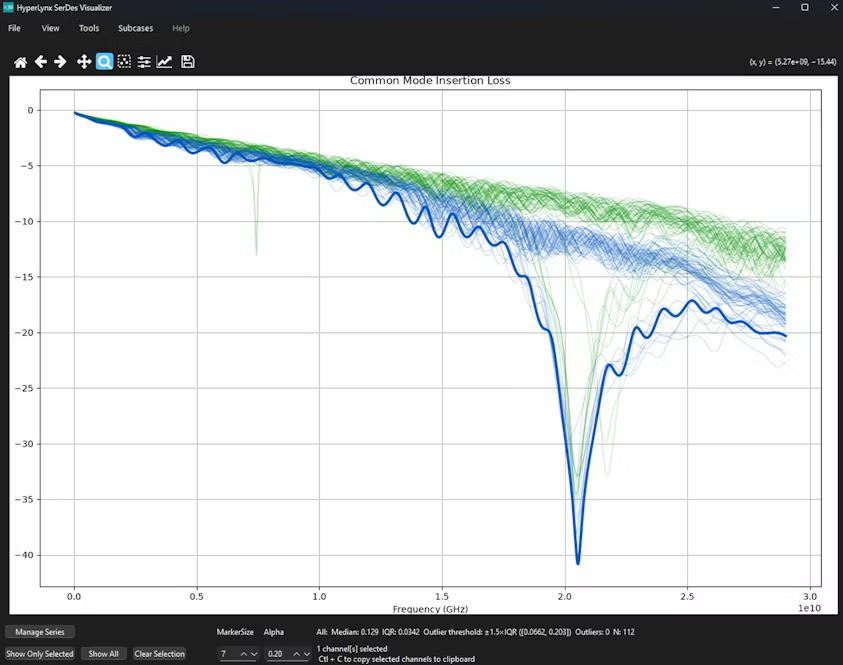
A built-in dashboard renders scatter plots (e.g., eye-height vs. eye-width) across multiple design alternatives, color-coded for signaling schemes such as PAM-4. Engineers can instantly spot outliers and drill down to the underlying netlist or layout fragment that caused the deviation.
Extending Agentic AI Across Siemens EDA
The HyperLynx Agentic Toolkit follows the launch of the Questa One Agentic Toolkit, Siemens’ first foray into AI-assisted functional verification. By unifying AI capabilities across functional (Questa) and physical (HyperLynx) verification, Siemens aims to provide an end-to-end, AI-first verification ecosystem. Anticipated roadmap items include:
- Cross-tool orchestration, where a single natural-language request can trigger both functional test generation in Questa One and SI/PI analysis in HyperLynx.
- Continuous-learning agents, which ingest post-silicon failure data to refine simulation models and margin recommendations.
Bottom Line
Siemens’ HyperLynx Agentic Toolkit injects domain-specific artificial intelligence directly into high-speed SI/PI verification, automating simulation setup, data mining, and decision support. For designs operating at 112 Gb/s and 224 Gb/s, the toolkit can shave weeks off the verification schedule while reducing the risk of late-stage redesigns. By extending its agentic-AI strategy across the EDA stack, Siemens positions itself as a pioneer of AI-first electronic design, offering engineers a powerful ally against the growing complexity of modern high-speed boards.