Key Takeaways
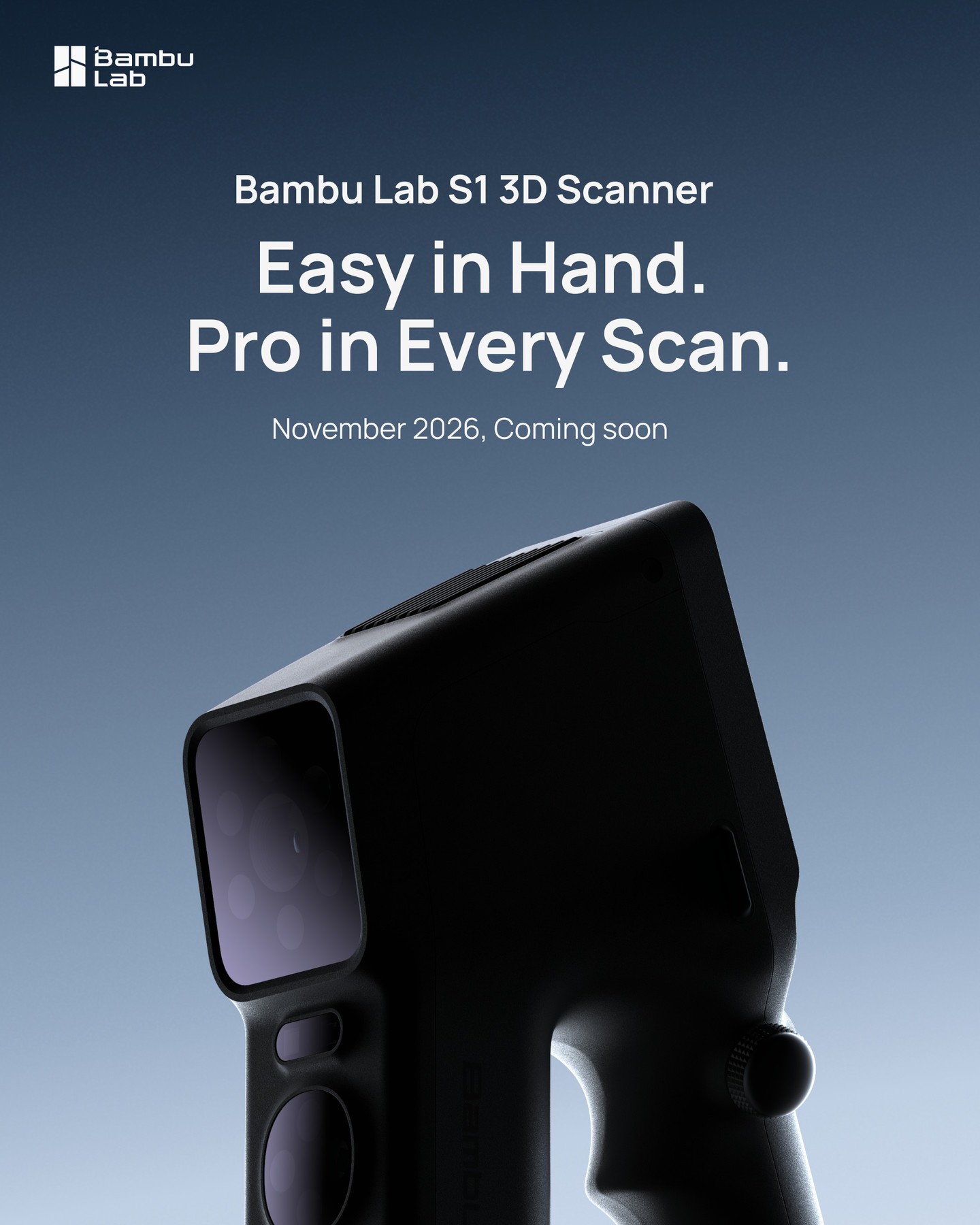
- Bambu Lab S1 is the company’s first 3‑D scanner, slated for a November 2026 launch.
- The device is positioned as the missing link in Bambu Lab’s “personal manufacturing hub,” complementing its desktop printers (X1‑Series) and laser‑cutting platform (H2D).
- Bambu Lab cites unreliable Wi‑Fi and steep learning curves as the two biggest pain points it intends to eliminate.
- Expected use‑cases span custom vehicle wraps, collectible replication, cultural‑heritage digitisation, and personalized apparel or medical devices.
- Compared with current consumer‑grade scanners, the S1 promises higher accuracy (≤ 0.05 mm) and faster capture (up to 30 fps) while retaining a sub‑$1,000 price target.
Bambu Lab’s Roadmap Beyond 3‑D Printing
From Desktop Printers to a Full‑Scale Toolset
Since 2022, Bambu Lab has expanded from its flagship X1‑Series FDM printers to the H2D laser‑cutting system (released March 2025). The H2D added a 600 mm × 600 mm cutting envelope and a 5 W fiber laser, targeting small‑batch manufacturing and prototyping. The upcoming S1 scanner is the next logical step, allowing users to capture real‑world geometry and feed it directly into the same workflow that prints or cuts parts.
The “Personal Manufacturing Hub” Vision
Bambu Lab’s stated mission is to democratise professional‑grade hardware for makers, designers, and micro‑enterprises. By bundling a printer, a cutter, and a scanner under a unified software ecosystem, the company aims to reduce the “tool‑chain friction” that typically forces users to juggle multiple brands and file formats.
What the S1 Scanner Is Designed to Solve
| Problem | Typical Impact | Bambu Lab’s Proposed Remedy |
|---|---|---|
| Unreliable wireless links | Dropped frames, corrupted meshes, re‑scans. | Built‑in dual‑band Wi‑Fi 6E + optional USB‑C tether for loss‑less data transfer. |
| Steep learning curve | Users need weeks of practice to achieve < 0.2 mm accuracy. | Guided on‑screen wizard, automatic exposure, and AI‑assisted surface stitching. |
| Inconsistent texture capture | Poor colour fidelity hampers AR/VR applications. | Integrated 12 MP RGB sensor with HDR imaging, calibrated against colour charts. |
Industry surveys (e.g., the 2025 3D Scanning User Experience report) indicate that 68 % of hobbyist users abandon scanning after the first failed attempt, underscoring the market need for a plug‑and‑play solution.
High‑Impact Applications
- Automotive styling: Scan a vehicle’s body panels to generate precise STL files for custom vinyl wraps or aerodynamic add‑ons.
- Collectibles & restoration: Capture a rare figurine at 0.05 mm resolution, then reproduce it via resin SLA or Bambu Lab’s own X1‑C printer.
- Cultural heritage: Digitise fragile artifacts for virtual museums; the S1’s non‑contact laser triangulation reduces risk of damage.
- Custom apparel & orthotics: Body‑scan a foot or torso to feed parametric clothing patterns or 3‑D‑printed orthotic insoles.
Beyond these, reverse‑engineering workflows—such as generating CAD models for obsolete replacement parts— stand to benefit from a tighter printer‑scanner loop.
How the S1 Stacks Up Against Current Consumer Scanners
| Feature | Bambu Lab S1 (expected) | Structure Sensor (Mark II) | EinScan‑Pro 2X | HP 3D Structured Light |
|---|---|---|---|---|
| Scanning method | Laser triangulation + RGB | Infrared depth + RGB | Structured light + RGB | Structured light |
| Accuracy | ≤ 0.05 mm | 0.2 mm | 0.1 mm | 0.15 mm |
| Capture speed | 30 fps | 15 fps | 20 fps | 12 fps |
| Field of view | 200 mm × 200 mm | 140 mm × 140 mm | 250 mm × 250 mm | 300 mm × 300 mm |
| Connectivity | Wi‑Fi 6E, USB‑C | Bluetooth 5.0, USB‑C | Wi‑Fi, USB‑C | Ethernet, Wi‑Fi |
| Software integration | Bambu Studio (single‑click import) | Canvas XR | EXScan | HP 3D Scan |
| Price (USD) | Target ≤ $999 | $399 | $2,299 | $3,500 |
Specs for the S1 are based on Bambu Lab’s public statements and typical component costs; final numbers may vary.
Anticipated Specifications & Pricing
- Resolution: 0.05 mm point‑cloud accuracy, 0.1 mm surface deviation.
- Capture volume: Up to 300 mm diameter, suitable for most desktop‑scale objects.
- Operating temperature: 5 °C – 40 °C, with auto‑calibration at start‑up.
- Software: Native plug‑in for Bambu Studio, supporting STL, OBJ, and PLY export.
- Price point: Bambu Lab hints at a “sub‑$1,000” launch price to keep the scanner accessible


