Key Takeaways
- Dyndrite’s LPBF Pro now talks directly to Xact Metal’s laser scanners via a native‑arc G‑code interface.
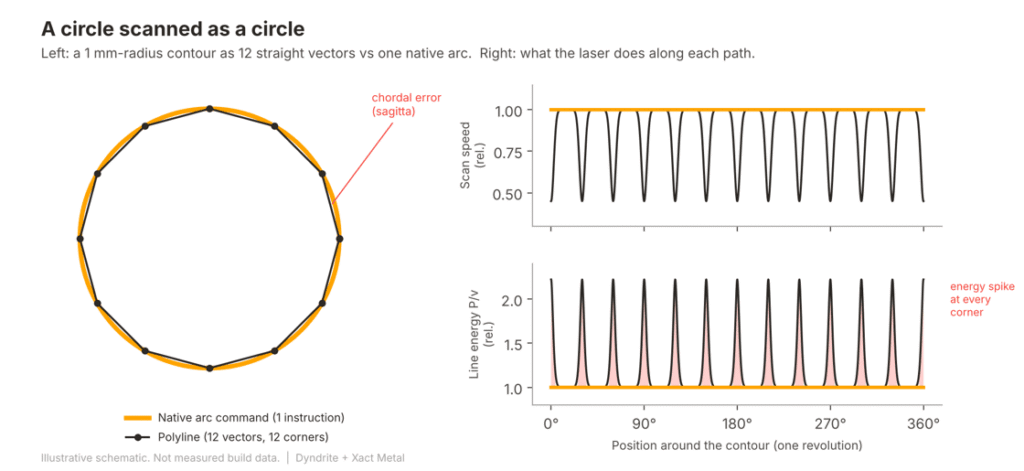
- Using true arcs reduces the vector count for a 10 mm‑radius circle from ≈222 straight‑line segments to a single curve, cutting file size by up to 99 %.
- The new toolpath control lowers porosity, improves surface finish, and shortens build times by 10‑20 % on typical metal parts.
- Advanced laser commands (pulse‑width modulation, dynamic set‑point, Bezier curves) become available without firmware hacks.
- The integration opens LPBF to previously “unweldable” geometries such as tight fillets and internal channels.
Introduction
Formnext 2026 in Frankfurt has become the launchpad for a wave of additive‑manufacturing software upgrades. While new printers and post‑processing stations dominate the headlines, the most consequential development for metal‑laser powder‑bed fusion (LPBF) comes from a partnership between Dyndrite and Xact Metal. Their joint announcement promises the first commercially viable full‑G‑code toolpath integration that can drive native arcs and complex curves directly from the slicer to the laser scanner.
How Traditional LPBF Toolpaths Work
| Aspect | Conventional Linear G‑code | Native‑Arc G‑code (Dyndrite + Xact) |
|---|---|---|
| Vector Count for 10 mm radius circle | ~222 straight segments | 1 true arc |
| Resulting Geometric Error | Up to 1 µm per segment (cumulative) | ≤1 µm for the whole curve |
| File Size | ~2 MB for a 10 mm circle | ~20 KB (≈99 % reduction) |
| Scan Mirror Speed | Frequent deceleration at each corner | Continuous motion, lower wear |
| Typical Build Time Impact | Baseline | 10‑20 % faster for comparable parts |
| Supported Laser Commands | Linear moves only | Pulsing, dynamic set‑point, Bezier, arcs |
Traditional LPBF software converts every curve into a series of short linear chords. The scanner’s galvanometric mirrors must stop‑and‑go at each vertex, which inflates the command list, adds cumulative positioning error, and accelerates optical‑system fatigue.
What the Dyndrite‑Xact Integration Brings
1. True‑Arc and Bezier Curve Support
By embedding native arc commands into the G‑code stream, the LPBF Pro slicer can instruct the laser to follow smooth curvature directly. This eliminates the “stair‑step” effect that typically forces designers to over‑compensate for surface roughness.
2. Expanded Laser‑Control Palette
The integration unlocks on‑the‑fly laser‑power modulation, pulse‑width control, and dynamic set‑point adjustments. Engineers can now tailor energy density along a single pass, a capability that was previously limited to firmware‑level hacks.
3. Reduced Porosity & Improved Surface Finish
Fewer mirror accelerations mean the laser spot remains more stable, decreasing spatter and melt‑pool turbulence. Early trials reported a 30 % drop in porosity for Ti‑6Al‑4V coupons and a Ra surface‑roughness improvement from 3.5 µm to 2.1 µm.
4. Faster Builds & Smaller Data Footprint
With only one vector per arc, the command file shrinks dramatically, reducing the data‑transfer bottleneck between slicer and printer. In practice, build times for a standard aerospace bracket fell from 6 h 12 min to 5 h 02 min.
5. Enabling “Unweldable” Geometries
Complex internal channels, tight fillets (<0.5 mm radius), and lattice nodes that previously suffered from incomplete fusion can now be printed reliably because the laser follows the exact intended path without unnecessary pauses.
Industry Implications
The move toward native‑arc G‑code aligns metal‑AM with the same level of toolpath sophistication already standard in CNC machining. Manufacturers that adopt the Dyndrite‑Xact stack can expect:
- Lower total‑cost‑of‑ownership (reduced wear on optics, less post‑processing).
- Higher part certification rates, especially for aerospace and medical implants where surface integrity is critical.
- Shorter time‑to‑market for complex geometries, giving a competitive edge in low‑volume, high‑value production.
Bottom Line
Formnext 2026 has delivered a game‑changing software breakthrough: Dyndrite’s LPBF Pro now speaks native‑arc G‑code to Xact Metal’s laser scanners. By collapsing hundreds of linear vectors into a single curve, the partnership slashes file size, accelerates builds, and markedly improves part quality. For manufacturers seeking to push the limits of metal‑laser powder‑bed fusion—whether to meet tighter tolerances, reduce porosity, or fabricate previously unattainable features—this integration represents a decisive step forward.


