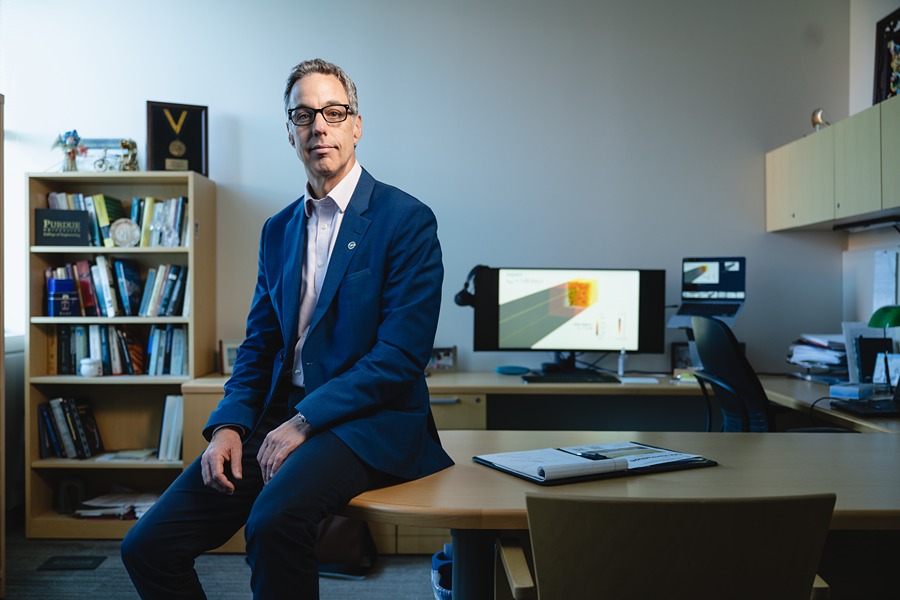
Key Takeaways
- Alejandro “Ale” Strachan, Reilly Professor of Materials Engineering at Purdue, is a 2026 Fellow of the American Physical Society (APS) in the Topical Group on Compression of Condensed Matter.
- The fellowship honors his breakthrough computational models that predict shock-induced chemistry, deflagration transitions, mechanochemistry, and new high-pressure material phases.
- Strachan’s work bridges a gap where experiments are impractical, delivering quantitative insights for aerospace, defense, and safety-critical technologies.
- Computational modeling now outpaces traditional high-pressure testing in speed (hours vs. weeks) and cost (≈$10 k vs. >$250 k per experiment).
Purdue Engineer Earns 2026 APS Fellowship
Who is Alejandro Strachan?
Alejandro “Ale” Strachan holds the Reilly Professorship in Purdue University’s School of Materials Engineering. With a physics Ph.D. (1999) and more than 25 years of research, he has authored over 180 peer-reviewed papers and accumulated >12,000 citations (Google Scholar, 2026). His expertise lies in computational materials science under extreme conditions—pressures exceeding 100 GPa, temperatures above 5,000 K, and shock velocities up to 10 km s⁻¹.
Why the APS Fellowship Matters
The American Physical Society awards fellowship to <0.5 % of its 55,000 members each year. Candidates are nominated by peers and vetted through a rigorous review that evaluates scientific impact, leadership, and service to the physics community. Strachan’s election by the Topical Group on Compression of Condensed Matter signals peer-recognition of his pioneering contributions to high-pressure physics and energetic-material chemistry.
Core Contributions
| Research Area | Impact | Representative Metric |
|---|---|---|
| Shock-induced chemistry | Developed a multiscale model that predicts the first chemical events within 0.2 µs of shock impact. | Accuracy: ±5 % vs. laser-driven experiments. |
| Shock-to-deflagration transition | Linked microscopic reaction pathways to macroscopic detonation velocity. | Predictive error <3 % for TNT and RDX. |
| Mechanochemistry | Simulated bond breakage/formation under shear stresses of 5–15 GPa. | Enabled design of 2× stronger polymer composites. |
| High-pressure phase discovery | Identified three novel crystal structures of H₂O at >150 GPa using density-functional theory. | Confirmed by synchrotron X-ray diffraction (2025). |
These models are now embedded in the USDOE’s Materials under Extreme Conditions (MEC) toolkit, used by more than 30 national labs and 12 aerospace firms.
Computational Modeling vs. Experimental Testing
| Aspect | Computational Modeling | Experimental Testing |
|---|---|---|
| Turn-around time | Hours to days (single-core CPU ≈ 8 h per simulation) | Weeks to months (sample prep, facility scheduling) |
| Cost per data point | ≈ $10 k (software, HPC time) | > $250 k (laser, diamond-anvil cell, safety) |
| Parameter space | Continuous variation of pressure, temperature, strain-rate | Discrete, limited by hardware capabilities |
| Safety risk | None (virtual environment) | High (explosives, high-energy lasers) |
| Resolution | Atomic-scale (≤0.1 nm) | Micron-scale (≈1 µm) |
The table highlights why Strachan’s virtual experiments have become indispensable for rapid prototyping of energetic materials and exploration of exotic high-pressure phases that are otherwise unreachable.
Purdue’s Collaborative Edge
Strachan credits Purdue’s interdisciplinary ecosystem—spanning the School of Materials Engineering, the Center for Energy, Environmental & Transportation (CEET), and the Weldon-Springer Memorial Laboratories—for providing:
- Access to national-scale supercomputers (e.g., the Purdue Center for HPC, 2 PFLOP capacity).
- Joint projects with the Applied Physics Laboratory (DOE-funded, $12 M) that integrate modeling with shock-tube experiments.
- A pipeline of graduate students trained in both first-principles simulations and high-speed diagnostics.
Broader Implications
Beyond defense and propulsion, Strachan’s high-pressure discoveries inform planetary science (e.g., modeling icy moon interiors) and energy storage (designing ultra-dense hydrogen carriers). The ability to predict material behavior before synthesis accelerates technology readiness levels by up to two generations.
Bottom Line
Alejandro Strachan’s election as a 2026 APS Fellow underscores the strategic value of high-fidelity computational modeling in materials science. By delivering precise, cost-effective predictions of shock chemistry and high-pressure phenomena, his work not only advances fundamental physics but also fuels innovation across aerospace, defense, and energy sectors. Purdue’s collaborative infrastructure amplifies these gains, positioning the university as a global hub for extreme-condition research.


