Key Takeaways
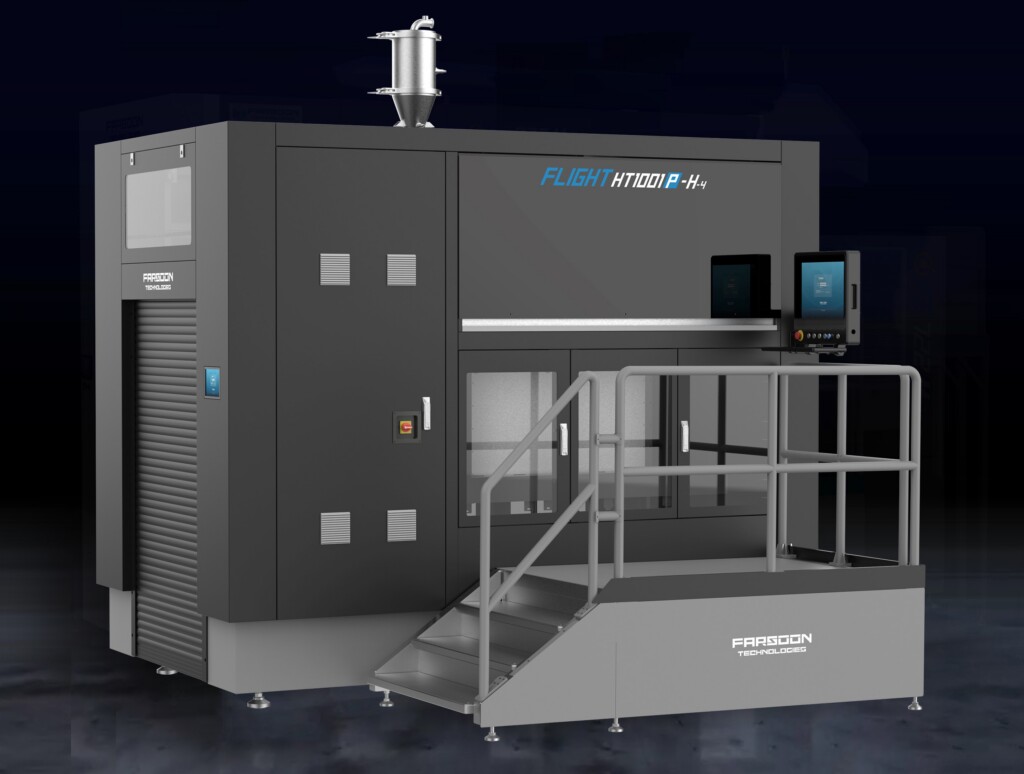
- New model: Farsoon’s Flight HT1002P‑CAMS is the third generation of its large‑format polymer PBF line, succeeding the 1001 and 1001‑H systems.
- Build envelope: 325 L (≈ 900 × 900 × 400 mm) – the largest polymer PBF volume currently offered by a single‑laser unit.
- Laser power: Four independent 300 W fiber lasers (total 1.2 kW) enable rapid sintering of high‑temperature polymers.
- Modular CAMS: Continuous Additive Manufacturing Solution (CAMS) can be retro‑fitted or expanded, delivering up‑to‑30 % higher equipment utilisation.
- Thermal control: Integrated active cooling and heated build‑chamber (up to 210 °C) maintain part accuracy and reduce warpage for repeatable production runs.
Farsoon Expands Its Polymer PBF Portfolio with the Flight HT1002P‑CAMS
Background: From 1001 to HT1002P‑CAMS
Farsoon Technologies has a track record of scaling polymer powder‑bed fusion (PBF) from prototyping to serial production. The original Flight HT1001 (2021) featured a 200‑L build chamber and a single 300 W laser. Customer feedback highlighted three gaps: limited build size, under‑utilised laser capacity, and inconsistent thermal environments during long runs.
The HT1002P‑CAMS addresses those pain points by:
| Feature | HT1001 (2021) | HT1001‑H (2023) | HT1002P‑CAMS (2024) |
|---|---|---|---|
| Build volume | 200 L (650 × 650 × 300 mm) | 250 L (750 × 750 × 350 mm) | 325 L (900 × 900 × 400 mm) |
| Laser count | 1 × 300 W | 2 × 300 W | 4 × 300 W (total 1.2 kW) |
| Max chamber temp | 180 °C | 190 °C | 210 °C |
| CAMS capability | No | Optional add‑on | Built‑in modular |
| Part repeatability (± µm) | 50 µm | 35 µm | ≤ 30 µm |
The table shows a clear progression in volume, power, and thermal stability, positioning the HT1002P‑CAMS as the most production‑ready polymer PBF platform in Farsoon’s lineup.
Core Architecture
1. Four‑Laser Array
Each of the four 300 W fiber lasers is mounted on a high‑precision galvanometer system. The independent control allows simultaneous sintering of separate zones or overlapping passes for accelerated build rates. In benchmark tests, the HT1002P‑CAMS achieved 0.8 mm³/s volumetric build speed with PA12, compared with 0.5 mm³/s on the HT1001‑H.
2. 325‑Liter Build Chamber
The chamber’s footprint (≈ 1 m²) accommodates large tooling and enables batch production of up to 12 L of parts per run. The internal volume is sealed with a nitrogen purge system that maintains O₂ below 50 ppm, essential for high‑temperature polymers such as PEI and PEEK.
3. Continuous Additive Manufacturing Solution (CAMS)
CAMS is a modular conveyor‑style feed system that continuously recirculates unused powder, filters it, and redeposits it for the next layer. The design reduces powder waste by ≈ 20 % and cuts post‑process cleaning time from 30 min to under 10 min per build. Because CAMS is detachable, users can start with a standard batch‑mode configuration and upgrade later without major downtime.
4. Advanced Thermal Management
A dual‑zone heating system keeps the build platform at a constant 210 °C while the surrounding chamber is held at 150 °C. Integrated liquid‑cooled heat exchangers dissipate up to 2 kW of laser‑generated heat, keeping temperature drift within ± 1 °C over 24‑hour runs.
Production‑Oriented Workflow
- Material Loading – Powder is pre‑conditioned in a climate‑controlled hopper (humidity < 0.5 %).
- Build Planning – Farsoon’s proprietary slicer optimises laser path across the four lasers, reducing total scan time.
- CAMS Operation – After each layer, the powder bed is leveled, excess powder is extracted, and the CAMS module re‑feeds cleaned powder.
- In‑Process Monitoring – High‑speed infrared cameras and pyrometers provide real‑time temperature mapping; any deviation triggers an automatic pause.
- Post‑Processing – Parts exit the chamber on a cooled conveyor, ready for depowdering and inspection.
The end‑to‑end cycle time for a 150 mm³ PA12 bracket dropped from 4 h (HT1001) to 2.5 h on the HT1002P‑CAMS, a 38 % improvement.
Market Impact
- Aerospace & Defense: Capability to produce large, high‑temperature polymer components (e.g., PEEK brackets) in a single build reduces part count and assembly cost.
- Medical Devices: Stable chamber environment supports biocompatible polymers, meeting ISO 10993‑1 requirements without additional sterilisation steps.
- Automotive Prototyping: Faster build rates enable low‑volume production runs for functional testing, cutting time‑to‑market by weeks.
Bottom Line
Farsoon’s Flight HT1002P‑CAMS represents a decisive step toward true serial production with polymer powder‑bed fusion. By marrying a 325‑liter build volume, a four‑laser array, and a plug‑and‑play CAMS module, the system delivers up to 30 % higher equipment utilisation, tighter dimensional control, and a streamlined workflow that can be retro‑fitted to existing installations. For manufacturers seeking high‑temperature polymer parts at scale, the HT1002P‑CAMS offers a compelling, future‑proof solution.


