Key Takeaways
- Strategic alliance: Aectual and Caracol join forces to bring on‑demand, recycled‑material 3D‑printed interiors closer to end‑users worldwide.
- Circular supply chain: Aectual’s products are manufactured, reclaimed, and re‑printed from 100 % recycled polymers, enabling true “take‑back” loops.
- Robotic scale‑up: Caracol’s Heron AM platform delivers up to a 2 m × 2 m × 1.5 m build envelope with a 300 kg payload, cutting lead‑times by 30‑40 % versus conventional batch printing.
- Global footprint: Through Caracol’s network of certified partners, Aectual now accesses local production capacity in Europe, North America, Asia‑Pacific and the Middle East.
- Recognition: The World Economic Forum named Aectual a 2026 UpLink Low‑Carbon and Circular Systems Challenge innovator, underscoring the partnership’s sustainability impact.
Introduction
Aectual, a pioneer in large‑scale, on‑demand 3D‑printed interior elements, has announced a partnership with robotic‑manufacturing specialist Caracol. The deal links Aectual’s growing international client base with Caracol’s distributed production ecosystem, allowing recycled‑material components to be fabricated close to the point of installation.
Aectual’s Circular 3D‑Printing Model
- Material loop: Products are printed from 100 % post‑consumer recycled PETG or nylon blends, then collected at end‑of‑life and re‑extruded for a new print cycle.
- Design flexibility: Aectual’s software library supports parametric geometry, enabling bespoke wall panels, acoustic baffles and desk accessories in volumes ranging from 0.2 m³ to 1.8 m³ per part.
- Market penetration: Over 150 commercial spaces across 12 countries have installed Aectual‑produced interiors, with flagship projects for Siemens (Berlin), Google (London) and IKEA (Stockholm).
Caracol’s Robotic Industrial Platform
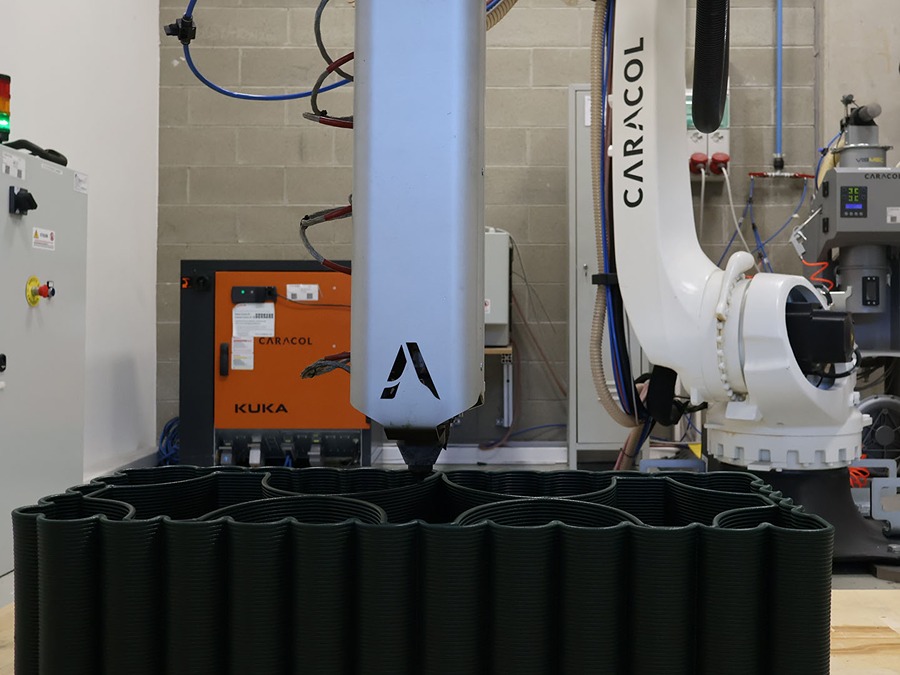
Caracol supplies the Heron AM system—a six‑axis robotic arm paired with a proprietary extrusion head. Core specifications include:
| Spec | Value |
|---|---|
| Build envelope | 2 m × 2 m × 1.5 m |
| Maximum payload | 300 kg |
| Layer resolution | 0.2 mm – 0.8 mm |
| Material feed rate | up to 200 kg h⁻¹ |
| Energy consumption | 350 kW (average) |
| Print speed advantage | 30‑40 % faster than traditional batch AM* |
*Source: Caracol Technical Data Sheet, 2025.
The platform integrates end‑to‑end software for nesting, toolpath optimization and real‑time process monitoring, ensuring repeatable quality across geographically dispersed sites.
How the Partnership Scales Circular Architecture
- Localized production: Caracol’s certified partners in key regions (e.g., Munich, Shanghai, Austin, Dubai) receive digital orders from Aectual and fabricate parts within 7‑10 days, eliminating trans‑ocean shipping.
- Reduced carbon footprint: By cutting average logistics mileage from 12,000 km to under 500 km per order, CO₂ emissions drop by an estimated 0.85 t CO₂e per 1 m³ of printed material.
- Supply‑chain resilience: The distributed model mitigates single‑point failures and aligns with “near‑shoring” trends highlighted in the 2024 Global Manufacturing Outlook.
Comparison: Aectual vs. Conventional Interior Fabrication
| Metric | Aectual + Caracol (circular) | Traditional CNC/Injection Mold |
|---|---|---|
| Material source | 100 % recycled polymers | Primarily virgin plastics |
| Lead‑time | 7‑10 days (local) | 4‑6 weeks (factory + shipping) |
| CO₂e per m³ | ~0.12 t | ~0.97 t |
| Design iteration cost | <$150 per variant | >$2,000 (tooling) |
| End‑of‑life | Closed‑loop take‑back | Landfill or down‑cycling |
Industry Implications
The Aectual‑Caracol alliance illustrates a viable pathway for large‑format additive manufacturing to transition from niche prototyping to mainstream, low‑carbon construction. By embedding circularity at the material level and leveraging a robotic, globally distributed production network, the partnership addresses two critical industry challenges: sustainability and speed‑to‑market.
Bottom Line
Aectual’s on‑demand, recycled‑material 3D‑printed interiors, now backed by Caracol’s high‑throughput robotic platform, represent a scalable model for circular architecture. The collaboration shortens supply chains, slashes emissions, and delivers bespoke interior